







Bears

Marine Mammals

Wolves & Kin

Hooves & Horns
Other
Availability: Undetermined - Enquiries?







In the Field
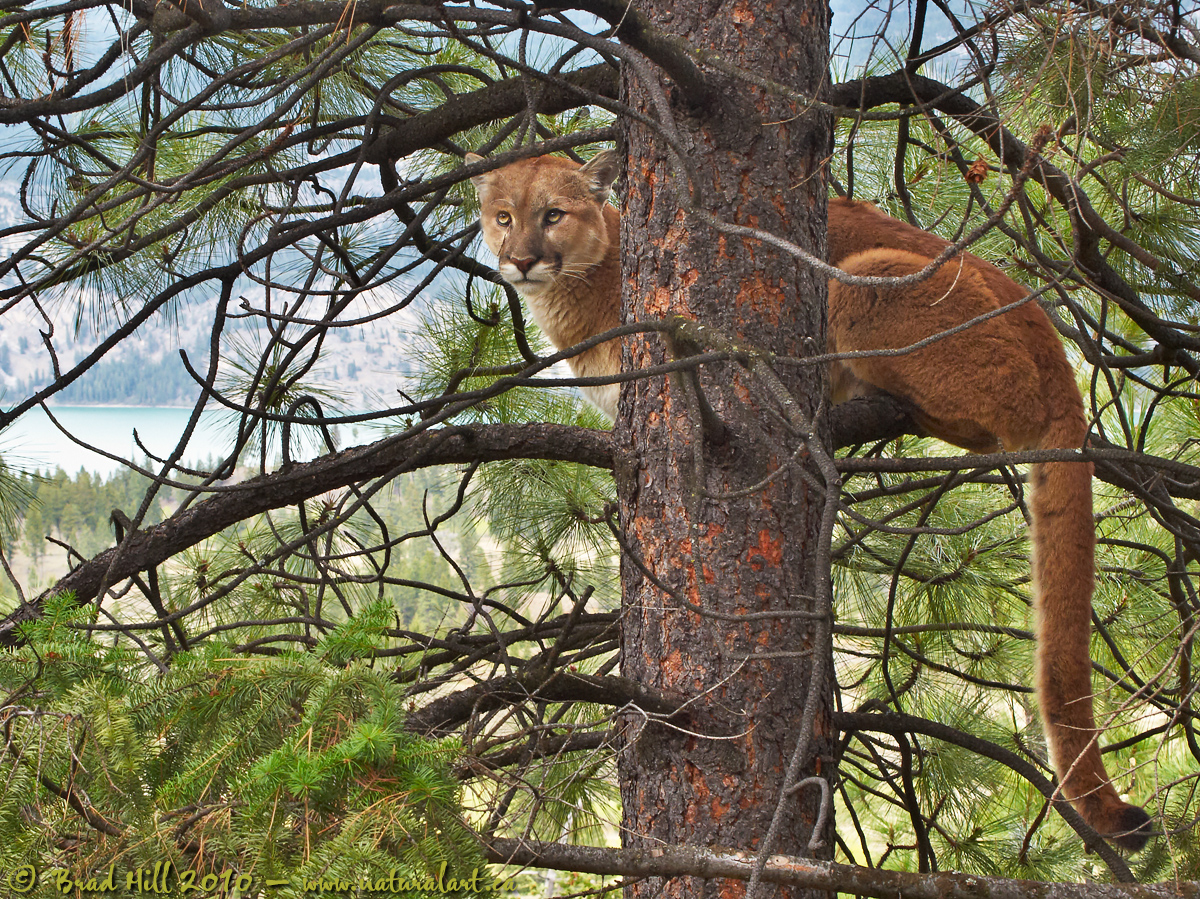
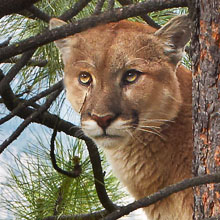
What's New Pussy Cat? Findlay Creek, BC, Canada. April 29, 2010.
I captured this image of a mature (and quite large) cougar during one of my daily "dog-walks" near our home in the East Kootenays of British Columbia. Because the probability of encountering wildlife of SOME form (at least deer or elk, but also possibly coyotes, wolves, bears, or cougars) during these walks is very high, I almost always carry a camera with me. About half the time I carry a dSLR and both a 70-200mm f2.8 VR zoom lens and a 28-70mm f2.8 zoom, and the other half the time I carry an Olympus E-P1 "Pen" (which, for those who don't know, is a sophisticated point & shoot camera with interchangeable lenses and a reasonably large image sensor and thus captures reasonably high-quality images, yet it's still very compact). The day I ran into this cougar, I decided to go light and was carrying "just" my little E-P1 (and I'm still kicking myself for making that decision!). The encounter had its drama, but - long story short - my dogs spooked the cat and inadvertently treed it. I was lucky that the tree it went up was beside a cliff face with ledges, so I was easily able to climb up some ledges and get even with the eye-level of the cat. At the time of this writing (May 3, 2010) I have only one lens for the E-P1 - a 12-42mm zoom (equivalent to a 28-84mm lens in 35mm SLR terms). The image shown here is about 80% of full frame, so it's obvious I was able to get quite close to my subject. Fortunately the kitty was quite cooperative and it allowed me the privilege of shooting this image!
I'm in LOVE with the idea of having a very compact, lightweight camera that I can carry anywhere and always have with me to capture high quality images of unexpected or spontaneous scenes when it's not practical to carry a real camera (= dSLR and lens or two) with me. And I think many other pro or serious enthusiast users of dSLR's have this same feelings. Thus, this cougar encounter provided information related to two questions that may interest many photographers...and may help many decide if purchasing a "just in case" high-end compact point & shoot is really worth it...
QUESTION 1: How well did the E-P1 handle the task of capturing a wildlife image in the field? The short answer - look at the image and you be the judge! This quality may completely satisfy some. For me, it's borderline. Shown at web-size the image is sufficiently sharp to please many. But, the full resolution image (viewed at 100%) is definitely significantly softer than what I could have captured if I had a dSLR with me (and a decent lens). I was extremely lucky to have a more-or-less captive subject (or at least a treed subject!) to work with - with the many branches in the scene (at different distances from the subject) I had to completely over-ride the autofocus system of the camera to get the cat in focus. And, using the manual focusing "aid" (of a 10x magnification of the scene in the camera's LCD), it was still darned tough, and darned slow, focusing on the cat. Of the 25 or so images of the cat in this pose, only one or two of them were sharp. In many (or most) situations where one is photographing wildlife you need almost instant focusing capabilities - if I had only seconds to capture this image (rather than minutes), I simply wouldn't have captured it. I guess the take home lesson is simply this: I got lucky! And, in most cases, anyone expecting to use a point & shoot (even a good one) to capture quality wildlife shots on a regular basis is likely to be a little dissatisfied with both the image capture process and the output quality is likely to be disappointed.
QUESTION 2: Should serious dSLR users consider purchasing a point & shoot to carry around for recording those "just in case" spontaneous scenes or encounters? This question is tough to provide a good generalizable answer for. Whether a quality point & shoot (like many of the newer - at the time of this writing - micro 4/3 systems) will work for you will depend largely on your own standard of "acceptable" image quality and your chosen subject matter. Odds are, most sports and wildlife shooters won't be happy - these cameras are simply too slow to work effectively with subjects that don't sit still for long. On the other hand, those shooting more static subjects (like scenics/landscapes, wildlfowers, sleeping children ;-), and general "capture the moment" (or documentary) images, make think the lens interchangeability and improved image quality of these "new" micro 4/3 point & shoots (compared to all those using the tiny image sensors common to most point & shoots) may love them.
Where do I stand on the issue? At a little under $800 CAD it's debatable if my Olympus E-P1 will actually pay for itself, given what i shoot and where my revenue comes from. But, I will capture some shots and memories I likely wouldn't otherwise (such as this image of the cougar). I don't think you'll see my E-P1 on the used market any time soon...
04 May 2010 Update: Since posting this image here (and on the Nature Photographer's Network), plus circulating it in among a group of fellow photographers, I've been receiving a recurring comment. The comment is that the shot doesn't look like one of my "normal" shots (but it's not being said negatively). Well, I hope it doesn't look like one of my normal shots! Two things - both related to the equipment I was forced to work with here - influenced how I had to approach this subject a little differently:
1. Lack of telephoto lens and lack of big aperture. This image was captured with an 84mm lens (in full-frame SLR equivalency). My normal modus operandi is captured by what has become my mantra: simplify and isolate. But, in this case, with an 84mm lens and without a huge aperture, I knew it was impossible to isolate my subject from the background (and all those branches). So, I took the opposite approach - stop down and create an image where detail is shown throughout the image, included the lake and distant hills in the background. That is, show the cat in its habitat. Thus the f10 setting. Interestingly, several folks have noticed this, and some have even liked it! Interesting...
2. Thinner dynamic range and less file "malleability". I'm used to shooting with a camera with a very wide dynamic range and that produces files that are VERY malleable, especially in terms of their "friendliness" of pulling out shadow detail without introducing noise. But, with this point & shoot I knew that at ISO 400 (required to get that f10 depth of field) I couldn't rely on pulling back shadow detail. So, I had to expose for the cat and let a little of the highlight detail in the background go. I knew I could bring enough of that highlight detail back to make the image presentable. Normally, with my "real" equipment I would have exposed a little differently (i.e., would have used a slight "under-exposure" and made sure I retained all the highlights, knowing that I could always bring back shadow detail).
So...maybe a little more thinking than "point & click" went into this shot! ;-)
Behind the Camera
What's New Pussy Cat? Findlay Creek, BC, Canada. April 29, 2010.
Digital Capture; RAW 12-bit format; ISO 400.
Olympus E-P1 with 14-42mm lens @ 42mm (84mm EFL). Hand-held. Manual focus over-ride.
1/60s @ f10; +0.33 stop compensation from metered exposure setting of camera.
At the Computer
What's New Pussy Cat? Findlay Creek, BC, Canada. April 29, 2010.
RAW Conversion to 16-bit TIFF, including first-pass/capture sharpening using Phase One's Capture One Pro 5. Three RAW conversions at different exposure settings. Exposure settings of -0.8 stops (to reduce brightness of background); 0 stops for the foreground vegetation; +0.3 stops for darker portions of the cougar (to draw out shadow detail).
Further digital corrections on 16-bit TIFF file using Adobe's Photoshop CS4 and Light Craft's LightZone. Photoshop adjustments included compositing and masking of 3 exposure versions, selective saturation of colours and selective sharpening for web output. Final tonemapping and tweaking performed with LightZone use the (tonemapper/re-light tool).
Conservation
What's New Pussy Cat? Findlay Creek, BC, Canada. April 29, 2010.
Information to follow.