





Natural Art: The Photography of Brad Hill

 
The Original Cute Little Devil!

Availability: Undetermined - Enquiries?


Previous Gallery Next Gallery

In the Field

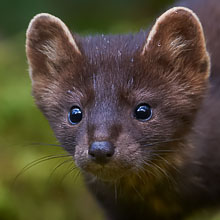
The Original Cute Little Devil! Great Bear Rainforest (on northern BC Coast), BC, Canada. October 9, 2011.

This is a shot that illustrates very well how - if you're not careful - nature can really throw you a curve. One would be hard-pressed to find a cuter animal anywhere on the planet than the American Marten - between their huge ears, inky black eyes, button nose, huge whiskers, and almost perfectly triangular head these little guys are the absolute living embodiment of the word "cute"! But the cuteness belies their true nature - these coldly efficient little carnivores sport amazingly sharp teeth and they're lightning quick. In short, to mice and squirrels these cuties are simply well-disguised little devils! Like most species of wildlife, under normal circumstances one could never get close enough to one to pet it (and I'm almost ashamed that the natural reaction of almost all non-habituated wildlife is to fear and flee from all humans), but if you did you'd be well advised to count your fingers shortly thereafter! ;-)

This image is nothing more than a lucky "grab" shot. I captured it while leading a photo tour into the Great Bear Rainforest in the autumn of 2011. At the time we were in a viewing stand where Spirit Bears (as well as black-coloured black bears) are known to visit. I had just taken my camera (and 600mm lens) off of a tripod when someone noticed this CLD (Cute Little Devil) trotting down a angled moss-covered fallen log that was at eye level (when looking out the back of the viewing stand). My camera was still in my hand and I had only enough time to raise it up, focus, and snap off a few shots using whatever settings my camera's controls were adjusted to (I had ZERO time to change anything!). I suppose one could argue that my ability to hand-hold a very bulky lens and how I set up the Auto-ISO function on my camera both contributed to the success of the image capture, but the reality is that I was really just darned lucky!

In a perfect world (i.e., the one I don't live in) this image would have a greater depth-of-field - I'd like it a whole lot more if the foreground was in focus (but with the background pleasingly blurred), but I can take some solace in the fact that the bits most necessary to illicit the "cute" response - the sensory organs of the head (the eyes, nose, whiskers and the ears) - are either sharply focused or, in the case of the ears, mostly in focus! ;-)

NOTE: This image was captured during one of my photo tours into a region of British Columbia known as "The Great Bear Rainforest". I offer both instructional photo tours and "photo op only" photo tours into the Great Bear Rainforest each spring and autumn. If you're interested in participating in one of these trips, just check out the Photo Tours page of this website!

Behind the Camera

The Original Cute Little Devil! Great Bear Rainforest (on northern BC Coast), BC, Canada. October 9, 2011.

Digital Capture; Compressed RAW (NEF) 14-bit format; ISO 3200

Nikon D3s with Nikkor 600mm f4 VRII lens - handheld. VR on and in "Normal" mode.

1/400s @ f5.6; -0.67 stop compensation from matrix-metered exposure setting.

At the Computer

The Original Cute Little Devil! Great Bear Rainforest (on northern BC Coast), BC, Canada. October 9, 2011.

RAW Conversion to 16-bit TIFF, including first-pass/capture sharpening using Phase One's Capture One Pro 6. Three exposure variants covering a 0.9 stop total range.

Further digital corrections on 16-bit TIFF file using Adobe's Photoshop CS5 and Light Craft's LightZone. Photoshop adjustments including compositing (layering and masking) the exposure variants and sharpening for web output. Final contrast/tone tweaking - particularly to mid-tones - performed with LightZone using the tonemapper/re-light tool.

Conservation

The Original Cute Little Devil! Great Bear Rainforest (on northern BC Coast), BC, Canada. October 9, 2011.

Ten percent of the revenue generated by this image will be donated to Pacific Wild

Species Status in Canada*: Newfoundland population Threatned; other populations within Canada not listed as Endangered, Threaten, or of Special Concern.

The American Marten (Martes americana) is a smallish tree-dwelling carnivore and a member of the weasel family (family Mustelidae). They possess a long silky and dense fur that has been coveted by the fur-trade industry for many decades (and earned the Marten the nickname "The American Sable"). In Canada and the bulk of North America Martens are normally associated with mature (old growth) coniferous and mixed-wood forests.

This American Marten was photographed in a region on the coast of BC known as the Great Bear Rainforest. This region is, at the time of this writing (October 25, 2011), facing a new and potentially catastrophic threat. There is a proposal to bring oil super-tankers through the narrow and treacherous channels of the Great Bear Rainforest. Any mishap - such as the one that sunk the Queen of the North ferry on March 22, 2006 - could result in an oilspill with disasterous consequences. Please visit the "No Pipeline/No Tankers Action Page" on Pacific Wild's website for suggestions on what YOU can do to help stop the tankers and/or sign the petition to Stop Oil Tankers. Thanks - this one is worth the effort to fight!

Pacific Wild is a non-profit conservation organization that is committed to:

1. Defending wildlife and their habitat on Canada's Pacific coast by developing and implementing solution-based conservation strategies. Pacific Wild supports innovative research, public education, community outreach and awareness to achieve the goal of lasting environmental protection in the lands and waters of the Great Bear Rainforest.

2. Working with a diverse array of communities, First Nations, groups and individuals to ensure that biodiversity protection is at the forefront of land and marine use decisions.

3. Mobilizing a concerned global citizenry to achieve large-scale wildlife protection.

Natural Art Images supports the efforts of Pacific Wild and encourages you to do the same.

*as determined by COSEWIC: The Committee on the Status of Endangered Wildlife in Canada