






Bears
Marine Mammals
Wolves & Kin
Hooves & Horns
Other
Availability: Undetermined - Enquiries?







In the Field
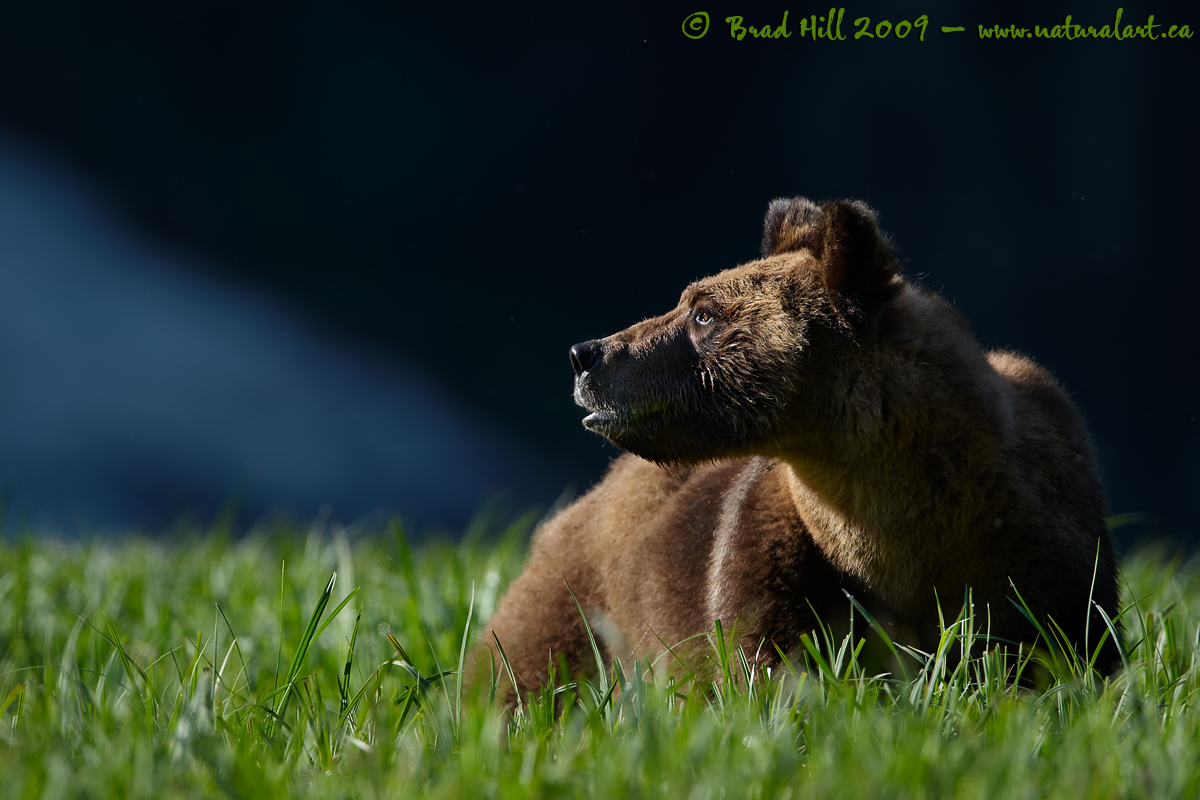
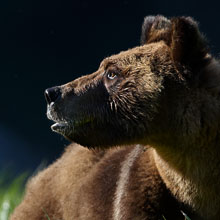
Simply a Griz... Khutzeymateen Inlet (Great Bear Rainforest), BC. June 2, 2009.
I tend to like simple, clean, compositions that have a minimum of distracting elements in them. I also tend to like the drama of directional lighting, with side-lighting being my preferred flavour of directional lighting. So when this adult female grizzly gave me this pose, you can imagine my feelings. But...it wasn't just a matter of clicking the shutter on this one - there were significant challenges during both the capture phase and the processing phase with this image...
As with most images, capturing this image with a minimum of distractions in the frame wasn't totally straightforward. The blue triangle in the background is actually a snowfield in very dark shade (the image was shot in the morning as the sun just came over a distant mountain peak), but it still had the potential to completely ruin the shot (and some may think that it still has ruined it!). We were floating just offshore in a Zodiac inflatable boat and drifting a little - I had to wait until I could "do something" with the snowfield. The bear wasn't moving too much, but eventually we were in a position where the snowfield formed a line which lead directly to the bear (i.e., a leading line!). Luckily enough, the bear looked up at just the right time and stared almost directly into the sun...
When I got around to examining the raw file of this shot I knew there were several processing challenges. To begin with, to preserve the highlights in this high-contrast scene I had to under-expose the original shot and there were many shadow regions on the bear that needed lightening up. Fortunately (and not accidentally), I had used a low ISO on this image, which meant that I could lighten the dark regions on the bear significantly without introducing any noticeable noise. Ultimately I used 3 separate raw conversions (differing in total by 2 full stops) - combined and blended in Photoshop - to balance the lighting on the bear.
And...that darned snowfield was WAY too bright (and distracting) in the original raw file. I'm not much of a cloner, but I did wonder how the image would look without ANY snowfield in the background. So, I duplicated the background layer, and cloned the snowfield away (using the dark background as source pixels). I didn't like the look without the snowfield (the image was just TOO simple), but thought that playing with the layer opacity of the top layer (the one without the snowfield) might be an interesting way to bring back the snowfield in a controlled way. Sure enough, after a little experimenting, I found that reducing the opacity of the cloned layer down to about 50% gave me the look I wanted - the snowfield was still there, but was no longer a liability to the image (at least to my eye). The blue look of the snowfield is natural and wasn't added by the use of cooling filters or adjusting the white balance of the raw file...
Anyway...if anyone thinks wildlife photography is just a matter of "...getting close to wildlife" (which I've heard many, many times), I have news for them - it's about a whole lot more...
This image was captured during my annual "Grizzlies of the Khutzeymateen" Instructional Photo Tour in the spring of 2009. If you're interested in joining me on one of my photo tours into the Great Bear Rainforest, check out the details on my "Photo Tours" page. My Instructional Photo Tours into the Great Bear Rainforest are run in conjunction with Ocean Light II Adventures - they offer a number of amazing adventure tours (including top-notch bear-viewing tours as well as tours of exploration of the Queen Charlotte Islands) and I highly recommend them!
Behind the Camera
Simply a Griz... Khutzeymateen Inlet (Great Bear Rainforest), BC. June 2, 2009.
Digital Capture; Compressed RAW (NEF) 14-bit format; ISO 200.
Nikon D3 with Nikkor 600 mm f/4G ED-IF AF-S VR lens - handheld from floating Zodiac. VR on and in "Normal" mode.
1/320s @ f5; -0.33 stop compensation from matrix-metered exposure setting of camera.
At the Computer
Simply a Griz... Khutzeymateen Inlet (Great Bear Rainforest), BC. June 2, 2009.
RAW Conversion to 16-bit TIFF, including first-pass/capture sharpening using Phase One's Capture One Pro 4.8. Three RAW conversions at different exposure settings. Exposure settings of conversions varied from -1.0 stops (to retrieve highlights on head of bear) through to +1.0 stops (to retrieve shadow detail on neck and side of bear's face).
Further digital corrections on 16-bit TIFF file using Adobe's Photoshop CS4. Photoshop adjustments included compositing/masking and blending of 3 exposure versions, balancing of brightness of background snowfield via adjusting opacity of layers without the snowfield (removed via cloning) and with the snowfield, selective colour saturation/desaturation and selective sharpening for web output.
Conservation
Simply a Griz... Khutzeymateen Inlet (Great Bear Rainforest), BC. June 2, 2009.
Ten percent of the revenue generated by this image will be donated to Raincoast*.
Species Status in Canada**: Special Concern (May 2002).
While Grizzly Bears (Ursus arctos) are not technically listed as "Endangered" in Canada, they have been extirpated from most of their historical range. Grizzly Bears are far more sensitive to intrusion/disturbance in their habitat than are Black Bears and are being increasingly forced into marginal habitat by human encroachment. The Great Bear Rainforest along the central and northern coast of British Columbia is one of the last strongholds of the Grizzly Bear in Canada, and even this population is coming under increasing pressure.
On December 18, 2017 the government of British Columbia banned grizzly hunting across the entire province. This major conservation victory came after decades of tireless work by many dedicated conservationists and ecologists and, most importantly, it reflects the opinion of the vast majority of British Columbians. And, it means that AT LEAST while the current government remains in power grizzlies are finally "safe" in British Columbia.
Now that we've at least temporarily won the battle to save grizzlies in BC, it's time to re-focus our efforts toward protecting ALL of BC's carnivores, including Gray Wolves, Black Bears, Cougars, Wolverines, and more! Simply put, there are no ecological, economic, or ethical arguments supporting the trophy hunting of carnivores.
In a great first step towards ending the hunting of carnivores throughout BC the Raincoast Conservation Foundation has developed a program designed to protect ALL carnivores within the Great Bear Rainforest. Details about this program can be found on this page on Raincoast's website. Check it out and, better yet, make a donation to help Raincoast purchase the remaining commercial hunting tenures in the Great Bear!
*The Raincoast Conservation Society (and Foundation) is an effective and efficient organization that has been fighting for protection of this unique habitat. If you are looking for a meaningful way to contribute to the conservation of this amazing ecosystem, Raincoast will provide maximal "bang" for your conservation dollars.
**as determined by COSEWIC: The Committee on the Status of Endangered Wildlife in Canada