






Bears
Marine Mammals
Wolves & Kin
Hooves & Horns
Other
Availability: Undetermined - Enquiries?








In the Field
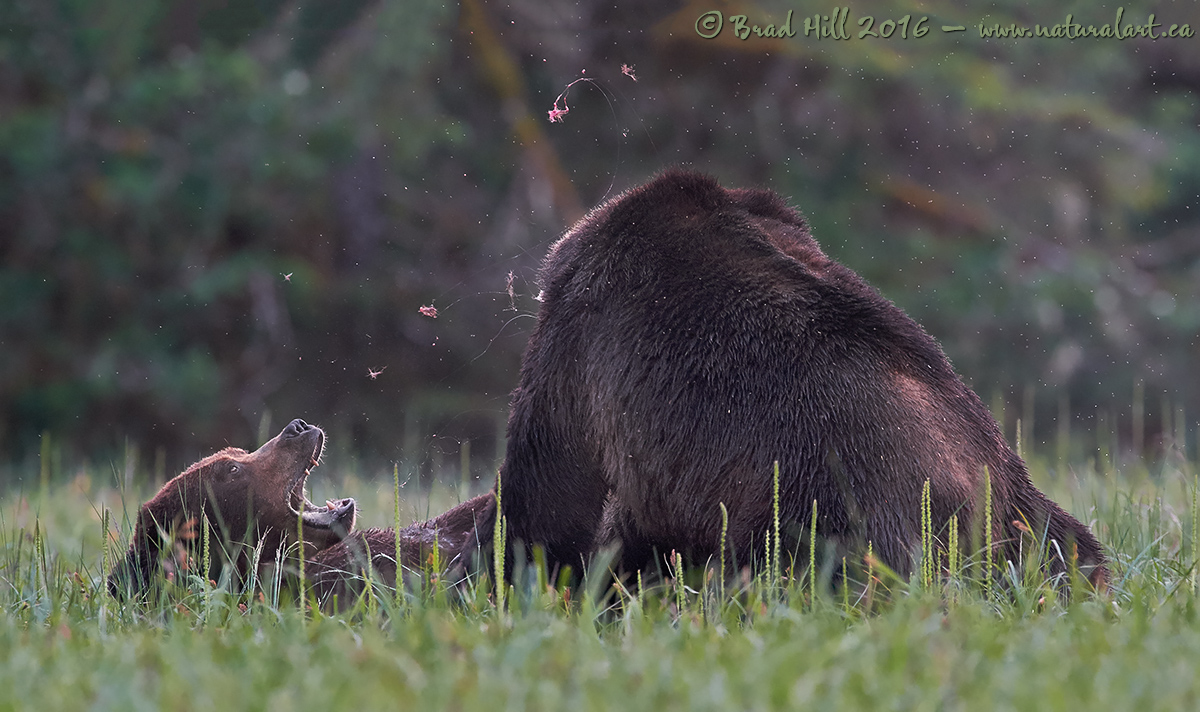
Raw, Sheer, Terror! Khutzeymateen Grizzly Sanctuary, northern BC coast, Canada, BC, Canada. May 28, 2015.
No matter how much time you spend in the field - or how many times you return to the same place or viewpoint - you can always see new things. I've spent a huge chunk of my life watching and photographing wildlife and wildlife behavior and have seen a lot of things. Those "things" include seeing countless sparring bouts between all of the North American species of bears. Many of these sparring bouts are between younger sub-adult bears - sometimes they're siblings, and sometimes not. But all that sparring seems to serve an important purpose - to teach the bears the signals and "rituals" and overall intraspecific behavior patterns that will be - or could be - important to them later in life.
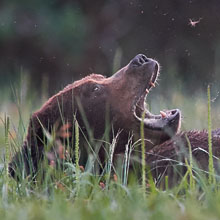
But this encounter we observed late one evening in the Khutzeymateen Grizzly Sanctuary in spring of 2015 was NO sparring match - and it was something I had never seen before. Long story short, the large adult bear on its back (the one literally screaming/roaring out in pain and terror) had been mating with several females on an alluvial fan for several days. And that's what he was doing this evening - until the MASSIVE bear on the right (which we had only seen once before a number of years back) literally rushed out of the woods to interrupt the proceedings and attack. What you're observing in this shot is about 45 seconds into the attack, and the huge ornery dude has taken down the "just big" bear and is proceeding to rip into its exposed lower abdomen region. And, yes, that's flying flesh and fur you see...
At the time we were absolutely convinced that the big bear's intent was to fully dispatch (AKA KILL!) of the smaller ("just big") male competitor. And, when I captured this shot, we were convinced he was disemboweling his "buddy". It was horrific and chilling.
This apparent brutality went on for a few minutes before the larger bear broke off the attack. It took several minutes before the beaten and defeated bear - which was in obvious shock - could climb onto its feet, and we assumed that he was literally dragging his entrails (though the long grass preventing us from confirming this). Over several minutes the injured bruin literally crawled/dragged himself out of our sight - and we assumed he was going to lie down and die. Over the next few minutes the "big bruiser" chased other males off and was in your basic rage - he even charged at us (we were safely off shore in a Zodiac with water between us and him!) and reared up his hind legs at water's edge and stomped on his hind feet.
The next morning "Big Bruiser" was still around - but had calmed down from his rage and was "sweet-talking" a female or two. And, there was no sign of Mr. "Just Big" bear.
So that evening - and over the following days - we assumed we had seen a full-blown male-on-male fight to the death. And...perhaps anthropomorphically...we were saddened that a bear we had enjoyed watching over a number of days (good old Mr. "Just Big") was gone. Then - 3 full days after the attack - who walks out of the forest almost good as new? Yep, Mr. "Just Big". Besides an open wound on his left thigh, he seemed none the worse for wear.
I've thought about that shocking fight - and looked at all the images I have of it - over the last several months. And...I'm left thinking we got it all wrong. Even though what we saw was horrific and shocking by human standards, I'm now convinced that "Big Bruiser" - even when in what looked like an uncontrollable rage - was still following rules and rituals that have evolved over many millennia and that he learned while sparring earlier in life. And, while he DID inflict pain (and certainly terror) on his foe, he was careful to not do any truly serious damage. He had the smaller bear at his mercy and could easily have killed him, yet he just did what he had to do to "clear the area" and enjoy the company of some willing females. It appears "Big Bruiser" learned a lot from all those sparring bouts he participated in during his younger years.
The moral of the story? In my mind it's this: It is so, so easy to allow our biases, "intelligence", and preconceptions colour what we see in the field...to the point of totally misinterpreting what we're seeing. This is particularly true when we watch carnivores - animals we've been conditioned to think of as vicious and dangerous - interact with one another. And it turns out their "viciousness" doesn't hold a candle to that of some humans. And we're supposedly the "civilized" ones!
Here's a higher resolution (2400 pixel) version of the shot for those wanting to see more detail:
• Raw, Sheer, Terror! Download 2400 pixel image (JPEG: 1.3 MB)
ADDITIONAL NOTES:
1. This image - in all resolutions - is protected by copyright. I'm fine with personal uses of them (including use as desktop backgrounds or screensavers on your own computer), but unauthorized commercial use of the image is prohibited by law. Thanks in advance for respecting my copyright!
2. This image was captured during one of my two spring "Grizzlies of the Khutzeymateen" photo tours in May/June of 2015. Each year I offer trips into two different parts of the Great Bear Rainforest as well as one to photograph aquatic mammals and oceanscapes near the northern tip of Vancouver Island. And, in selected years, I also offer photo tours to locations to capture other highly sought-after subjects, such as various boreal owl species and wildlife of Canada's Arctic. Details about these trips can be found on the Photo Tours page of this website.
3. Like all wildlife photographs on this website, this image was captured following the strict ethical guidelines described in The Wildlife FIRST! Principles of Photographer Conduct. I encourage all wildlife photographers to always put the welfare of their subjects above the value of their photographs.
Behind the Camera
Raw, Sheer, Terror! Khutzeymateen Grizzly Sanctuary, northern BC coast, Canada, BC, Canada. May 28, 2015.
Digital Capture; Compressed RAW (NEF) 14-bit format; ISO 7200.
Nikon D4s paired with Nikkor 400mm f2.8E VR plus TC-20EIII (2.0x) teleconverter, for a total focal length of 800mm. Hand-held from floating Zodiac. VR on and in "Sport" mode.
1/800s @ f8; -0.67 stop compensation from "recommended" matrix-metered exposure setting.
At the Computer
Raw, Sheer, Terror! Khutzeymateen Grizzly Sanctuary, northern BC coast, Canada, BC, Canada. May 28, 2015.
RAW Conversion to 16-bit TIFF using Phase One's Capture One Pro 9. Four raw variants (different versions of a single raw capture) processed, with the variants differing in exposure settings (0.7 stop total difference between the variants), highlight recovery, and noise reduction settings.
Further digital corrections on resulting 16-bit TIFF files using Adobe's Photoshop CC 2015 and Light Crafts Lightzone. Photoshop adjustments included compositing (blending) of the four output files from the raw converter, minor exposure tweaks, selective application of a yellow Photo Filter, and final selective sharpening for web output. Final tone-tweaking performed using LightZone's "tonemapper" tool.
Conservation
Raw, Sheer, Terror! Khutzeymateen Grizzly Sanctuary, northern BC coast, Canada, BC, Canada. May 28, 2015.
Ten percent of the revenue generated by this image will be donated to Raincoast*.
Species Status in Canada**: Special Concern (May 2002).
While Grizzly Bears (Ursus arctos) are not technically listed as "Endangered" in Canada, they have been extirpated from most of their historical range. Grizzly Bears are far more sensitive to intrusion/disturbance in their habitat than are Black Bears and are being increasingly forced into marginal habitat by human encroachment. The Great Bear Rainforest along the central and northern coast of British Columbia is one of the last strongholds of the Grizzly Bear in Canada, and even this population is coming under increasing pressure.
On December 18, 2017 the government of British Columbia banned grizzly hunting across the entire province. This major conservation victory came after decades of tireless work by many dedicated conservationists and ecologists and, most importantly, it reflects the opinion of the vast majority of British Columbians. And, it means that AT LEAST while the current government remains in power grizzlies are finally "safe" in British Columbia.
Now that we've at least temporarily won the battle to save grizzlies in BC, it's time to re-focus our efforts toward protecting ALL of BC's carnivores, including Gray Wolves, Black Bears, Cougars, Wolverines, and more! Simply put, there are no ecological, economic, or ethical arguments supporting the trophy hunting of carnivores.
In a great first step towards ending the hunting of carnivores throughout BC the Raincoast Conservation Foundation has developed a program designed to protect ALL carnivores within the Great Bear Rainforest. Details about this program can be found on this page on Raincoast's website. Check it out and, better yet, make a donation to help Raincoast purchase the remaining commercial hunting tenures in the Great Bear!
*The Raincoast Conservation Society (and Foundation) is an effective and efficient organization that has been fighting for protection of this unique habitat. If you are looking for a meaningful way to contribute to the conservation of this amazing ecosystem, Raincoast will provide maximal "bang" for your conservation dollars.
**as determined by COSEWIC: The Committee on the Status of Endangered Wildlife in Canada