






Bears
Marine Mammals
Wolves & Kin
Hooves & Horns
Other
Availability: Undetermined - Enquiries?








In the Field
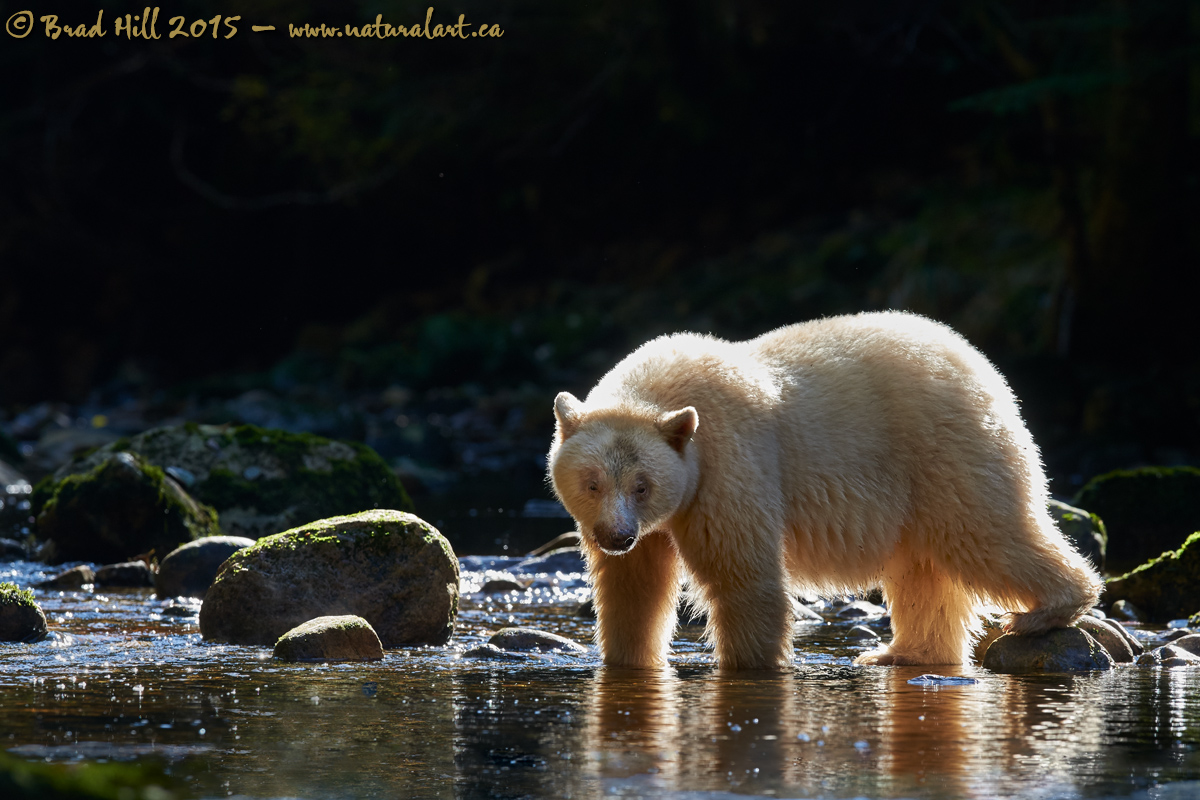
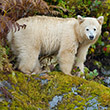
Spirit of the Rainforest. Great Bear Rainforest (central BC coast), BC, Canada. October 4, 2015.
The rare white-coated variant of the black bear that is primarily found within a small section of British Columbia's central coast has a strong cultural and almost spiritual significance to the local First Nations. When this Spirit Bear wandered out of the forest and into this stream with almost blinding sunshine illuminating it from behind I finally understood why.
An interesting thing happened when this cooperative bear provided this photographic opportunity to us - I initially decided to put my camera down and not even bother taking the shot. Why? Because I knew that there wasn't a camera on the market that could capture the full dynamic range of the scene - the contrast was simply so far "off the charts" that there was NO way there wouldn't be detail lost in the brights or in the shadows (or both). But then I looked at the scene again and realized that it was SO contrasty that even my EYES couldn't handle the full dynamic range - I couldn't see a darned bit of detail on the back of the bear - it was completely blown out to my eyes. So I thought "what the heck" and I grabbed my most readily available camera with the highest dynamic range (my D750), estimated an exposure compensation that would leave SOME detail in most of the white regions as well as give me a LITTLE shadow detail to work with, and fired away.
The moral of the story? Sometimes you have to ignore your instincts! As a wildlife photographer with a technical bent, I've trained my eye to recognize scenes that my camera has the ability to capture and render in a natural way (though often the camera doesn't get it quite right...and one has to "help" the image along with your post-processing skills). One consequence of this is that I often quickly turn away from scenes that I know exceed the dynamic range of my camera. BUT...if those scenes ARE eye-catching - and if they exceed the dynamic range of one's EYES - why not capture them? While this is definitely NOT even close to being my personal favourite Spirit Bear photo (and I'm sure some will criticize it for the blown highlights), it does bring back that memory of the "glowing" Spirit Bear from the autumn of 2015. And it helps me appreciate why this unique animal has become known as "The Spirit Bear." And yes, the highlights are blown. ;-)
Here's a higher-resolution (2400-pixel) version of this glowing bear for your perusal and downloading pleasure:
• Spirit of the Rainforest: Download 2400 pixel image (JPEG: 1.3 MB)
ADDITIONAL NOTES:
1. This image - in all resolutions - is protected by copyright. I'm fine with personal uses of them (including use as desktop backgrounds or screensavers on your own computer), but unauthorized commercial use of the image is prohibited by law. Thanks in advance for respecting my copyright!
2. Like all wildlife images on this website, the subject(s) is/are fully wild and completely unconstrained. Besides the potential impact of my/our presence, nothing has been done to intentionally alter or affect the ongoing behavior of the subject and, of course, there has been no use of any form of bait or other form of wildlife attractants (including vocalizations).
3. This image was captured during my autumn "Into the Great Bear Rainforest" photo tour in October of 2015. Each year I offer trips into two different parts of the Great Bear Rainforest as well as one to photograph marine mammals and oceanscapes near the northern tip of Vancouver Island. And, in selected years, I also offer photo tours to locations to capture other highly sought-after subjects, such as various boreal owl species and wildlife of Canada's Arctic. Details about these trips can be found on the Photo Tours page of this website.
Behind the Camera
Spirit of the Rainforest. Great Bear Rainforest (central BC coast), BC, Canada. October 4, 2015.
Digital Capture; Compressed RAW (NEF) 14-bit format; ISO 800.
Nikon D750 paired with Nikkor 400mm f2.8E VR. Hand-held. VR on and in "Sport" mode.
1/400s @ f7.1; -1.0 stop compensation from "recommended" matrix-metered exposure setting.
At the Computer
Spirit of the Rainforest. Great Bear Rainforest (central BC coast), BC, Canada. October 4, 2015.
RAW Conversion to 16-bit TIFF using Phase One's Capture One Pro 8. Three raw variants (different versions of a single raw capture) processed, with the variants differing in exposure (0.5 stop total difference between the variants) and in both highlight and shadow retrieval settings.
Further digital corrections on resulting 16-bit TIFF files using Adobe's Photoshop CC 2015 and Light Crafts Lightzone. Photoshop adjustments included compositing (blending) of the three output files from the raw converter, minor exposure tweaks, and final selective sharpening for web output. Final tone-tweaking performed using LightZone's "tonemapper" tool.
Conservation
Spirit of the Rainforest. Great Bear Rainforest (central BC coast), BC, Canada. October 4, 2015.
Ten percent of the revenue generated by this image will be donated to Raincoast*.
Species Status in Canada**: Not currently listed as Threatened or Endangered.
The "Spirit" Bear is a rare genetically-based colour variant of the common Black Bear (Ursus americana). It has been estimated that less than 300 Spirit Bears exist today. Because the Black Bear is not considered under threat as a species, the Spirit Bear suffers from having the same conservation designation (it should be acknowledged that in British Columbia - the jurisdiction of greatest Spirit Bear abundance - hunting of these white-coated bears is not permitted). For reasons that are not fully understood, the Spirit Bear occurs with greater frequency in a relatively small geographic area within The Great Bear Rainforest of the central and northern coast of British Columbia. In this area 10 to 30% of the bears possess white coats. Many of the black-coloured Black Bears in this region carry the gene for white coats, so allowing hunting of ANY Black Bears in this region can reduce the frequency of the gene for white coats. Thus, to protect the Spirit Bear, it is necessary to prohibit the hunting of ALL Black Bears in this region. And, very unfortunately, the globally unique ecosystem that contains the Spirit Bear is under development pressure, especially from the forestry industry. If this unique environment is altered, we may lose the wonderful genetic anomaly known as the Spirit Bear forever.
*The Raincoast Conservation Society (and Foundation) is an effective and efficient organization that has been fighting for protection of this unique habitat. If you are looking for a meaningful way to contribute to the conservation of this amazing ecosystem, Raincoast will provide maximal "bang" for your conservation dollars.
**as determined by COSEWIC: The Committee on the Status of Endangered Wildlife in Canada