






Bears
Marine Mammals
Wolves & Kin
Hooves & Horns
Other
Availability: Undetermined - Enquiries?







In the Field
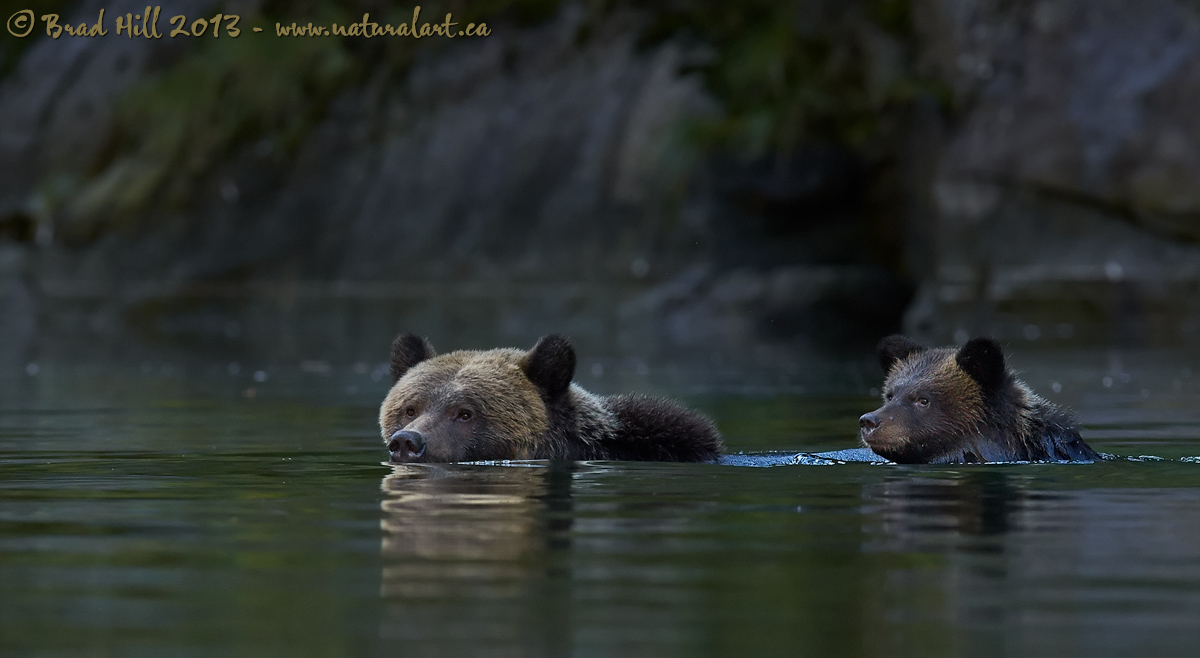
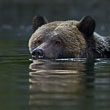
Evening Dip in the Great Bear Rainforest. Great Bear Rainforest (central BC coast), BC, Canada. October 4, 2012.
Adult grizzly bears are completely comfortable in water - and even young cubs quickly get over their initial hesitation to "hang out" in water. Watch grizzlies in water for awhile and it's easy to understand how some of them diverged a few thousand years ago and became even more aquatic (that would be their close brethren - the polar bear).
When I'm photographing grizzly bears - or any animal for that matter - in calm water I like to do two things. First, shoot from a very low angle. Second, use a fairly wide aperture. Combined these two little things can create a very soft, silky, and aesthetically appealing look to the water. And, it can help to make your subject (which is hopefully sharply focused!) absolutely "pop" visually. But, if you're working with multiple subjects, effectively using a wide aperture (and thus a thin depth-of-field) can be extremely tough - in most instances one or more of those subjects will be out-of-focus and detract from the image. So...when this female grizzly bear and her cub swam out into a channel in soft, late-day light, then absolutely stopped and "hovered" in the water while watching something in the distance (the "something" being another bear) AND then both lined up in the same plane of focus...well I knew it was my lucky day. And I suppose it was even luckier that I had my uber-sharp 400mm f2.8 VR lens in my hand and was in a zodiac in the channel and close to the water level. Not a bad way to end the day...
'Nuff said - enjoy.
NOTE: This image was captured during one of my "Into the Great Bear Rainforest" photo tours in 2012. Each year I offer trips into two different parts of the Great Bear Rainforest. Each spring we visit the northern portion of the Great Bear Rainforest during my two "Grizzlies of the Khutzeymateen" photo tours. And each autumn we travel through the heart of the Great Bear Rainforest during my two 7-day "Into the Great Bear Rainforest" photo tours. Details about these trips can be found on the Photo Tours page of this website.
Behind the Camera
Evening Dip in the Great Bear Rainforest. Great Bear Rainforest (central BC coast), BC, Canada. October 4, 2012.
Digital Capture; Compressed RAW (NEF) 14-bit format; ISO 1800
Nikon D4 paired with Nikkor 400mm f2.8 VRII lens. Hand held from floating Zodiac. VR on and in normal mode.
1/400s @ f5.6; -1.0 stop compensation from matrix-metered exposure setting.
At the Computer
Evening Dip in the Great Bear Rainforest. Great Bear Rainforest (central BC coast), BC, Canada. October 4, 2012.
RAW Conversion to 16-bit TIFF, including first-pass/capture sharpening using Capture One Pro Version 6. Three raw variants (processed from raw) differing by a total of 0.67 stops in exposure.
Further digital corrections on resulting 16-bit TIFF files using Adobe's Photoshop CS6 and Light Craft's Lightzone. Photoshop adjustments included compositing the raw conversion exposure variants, selective minor tweaks to exposure, selective colour saturation and desaturation, and selective sharpening for web output. Final tone tweaking performed using tonemapper/re-light tool in Lightzone.
Conservation
Evening Dip in the Great Bear Rainforest. Great Bear Rainforest (central BC coast), BC, Canada. October 4, 2012.
Ten percent of the revenue generated by this image will be donated to Raincoast*.
Species Status in Canada**: Special Concern (May 2002).
While Grizzly Bears (Ursus arctos) are not technically listed as "Endangered" in Canada, they have been extirpated from most of their historical range. Grizzly Bears are far more sensitive to intrusion/disturbance in their habitat than are Black Bears and are being increasingly forced into marginal habitat by human encroachment. The Great Bear Rainforest along the central and northern coast of British Columbia is one of the last strongholds of the Grizzly Bear in Canada, and even this population is coming under increasing pressure.
On December 18, 2017 the government of British Columbia banned grizzly hunting across the entire province. This major conservation victory came after decades of tireless work by many dedicated conservationists and ecologists and, most importantly, it reflects the opinion of the vast majority of British Columbians. And, it means that AT LEAST while the current government remains in power grizzlies are finally "safe" in British Columbia.
Now that we've at least temporarily won the battle to save grizzlies in BC, it's time to re-focus our efforts toward protecting ALL of BC's carnivores, including Gray Wolves, Black Bears, Cougars, Wolverines, and more! Simply put, there are no ecological, economic, or ethical arguments supporting the trophy hunting of carnivores.
In a great first step towards ending the hunting of carnivores throughout BC the Raincoast Conservation Foundation has developed a program designed to protect ALL carnivores within the Great Bear Rainforest. Details about this program can be found on this page on Raincoast's website. Check it out and, better yet, make a donation to help Raincoast purchase the remaining commercial hunting tenures in the Great Bear!
*The Raincoast Conservation Society (and Foundation) is an effective and efficient organization that has been fighting for protection of this unique habitat. If you are looking for a meaningful way to contribute to the conservation of this amazing ecosystem, Raincoast will provide maximal "bang" for your conservation dollars.
**as determined by COSEWIC: The Committee on the Status of Endangered Wildlife in Canada