






Mammals
Birds
Animalscapes

Natural Art
Collections
Latest
Availability: Undetermined - Enquiries?










In the Field
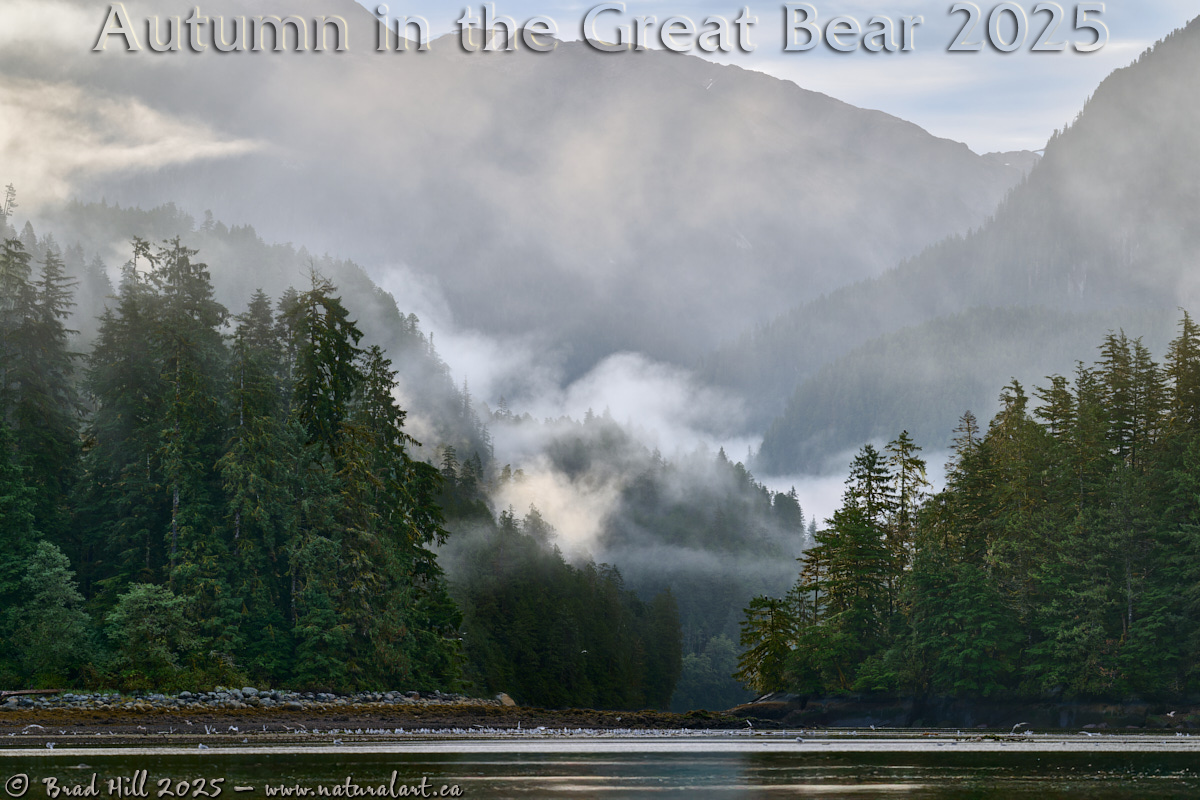
Autumn Daybreak. Great Bear Rainforest, British Columbia, Canada. September 23, 2025.
If you're wondering if there's ANY true wilderness left in the world I can assure you there is. And, with this image, you're looking at it. This image was captured in one of the many remote estuaries in the Great Bear Rainforest of British Columbia. In this shot you're looking to the southeast of the main estuary and at the entrance of a saltwater lagoon that's 1.9 nautical miles (3.5 km) long. The nearest road is at least 81 nm (150 km) away - as the raven flies. The primary local (and non-photosynthesizing) inhabitants? In the autumn - and ranked by biomass - it's salmon, gulls, eagles, bears, and wolves (tho' I have to admit I have no idea of the biomass of the local rodents or how they rank in the big picture!). Where are the people in this picture? Not part of it...
I am not a serious landscape photographer. At best I am an opportunistic landscape photographer who captures quick grab-shots of landscapes as they unfold in front of me while I'm engaged in wildlife photography. This grab shot was captured from a moving Zodiac inflatable boat using a Nikon Z 9 camera with a Sigma Sports 200mm f2 lens (Sony mount; adapted to Nikon Z mount using a Megadap Pro+ mount adapter).
I like using focal length ranges from about 50mm to 200mm to shoot landscapes, and I shoot an awful lot of them between 120mm and 200mm. Why? Partly because of the narrow field of view (relative to wide angle lenses) that allows me to "subsample" the scene and keep messy elements out of the shot. I also quite like the compression effect you get with the longer focal lengths. As a wildlife photographer I'm also quite used to looking at scenes as they appear through a telephoto lens - I'm quite good at "seeing" good landscape opportunities that are in the distance And, I suppose, another reason for me liking slightly longer lenses for landscapes is simply because I'm crappy at using wide angle lenses! 😉
One of the very strong points of using the Sigma 200mm f2 lens for landscape shooting is just how amazingly sharp it is from edge-to-edge, including when shot wide open at f2. In this case - and largely because I was shooting from a moving boat - I didn't have the luxury of stopping down to a smaller aperture (unless, of course, I wanted to bump the ISO way up). So the super-wide aperture of the 200 f2 proved highly useful!
Here's a larger version (4800 pixel) of this misty, moody scene:
• Autumn Daybreak: Download 4800 pixel image (JPEG: 5.2 MB)
ADDITIONAL NOTES:
1. These images - in all resolutions - are protected by copyright. I'm fine with personal uses of them (including use as desktop backgrounds or screensavers on your own computer), but unauthorized commercial use of the image is prohibited by law. Thanks in advance for respecting my copyright!
2. Like all photographs on this website, these images were captured following the strict ethical guidelines described in The Wildlife FIRST! Principles of Photographer Conduct. As such, no baiting or any form of attractant was used and, as always, we attempted to minimize our impact on the ongoing behaviour of the subjects. I strongly encourage all wildlife photographers to always put the welfare of their subjects above the value of their photographs.
3. This image was captured during my Autumn in the Great Bear Exploratory Photo Adventure in early Autumn of 2025. Each year I offer photo tours into various locations on the amazing BC coast, including the Great Bear Rainforest and, every other year, into the Khutzeymateen Grizzly Sanctuary (to photograph grizzlies, of course!). Details about these trips can be found on the Photo Tours page of this website.
Behind the Camera
Autumn Daybreak. Great Bear Rainforest, British Columbia, Canada. September 23, 2025.
High Efficiency* Compressed RAW (NEF) format; ISO 64.
Nikon Z 9 paired with Sigma 200mm f2.0 DG OS Sports adapted to the Z-mount using a Megadap ETZ21 Pro+ mount adapter. Hand-held from moving Zodiac. VR on camera off; OS on lens on and set to Mode 1. Single-point AF area mode.
1/500s @ f2.2; No compensation from matrix-metered exposure setting.
At the Computer
Autumn Daybreak. Great Bear Rainforest, British Columbia, Canada. September 23, 2025.
Initial noise reduction and capture sharpening on the .nef (raw) file using the DeepPRIME XD2S algorithm of DXO PhotoLab 9.1 Elite (using the lens/camera optical module of the Nikon Z9 + Nikkor 200mm f2 VR II).
Subsequent adjustments to the adjusted linear DNG file (exported from PhotoLab) and conversion to 16-bit TIFF file (and JPEG files for web use) - including all global and selective adjustments - made using Capture One Pro (build 16.6.3). In the case of this image two global adjustments were made - a reduction of the highlights and a overall contrast bump using the Levels tool. Selective local adjustments performed using Capture One Pro's layers and masking tools. In this case numerous small adjustments and minor tweaks were made on 4 separate layers, with the tweaks being associated with "exposure balancing" and contrast adjustments (such as adjustments to brightness, clarity, highlights, shadows, blacks, etc.). I also made a very slight (and highly selective) tweak to the colour balance on portions of the fog that were directly illuminated by the warm rising sun.
Photoshop modifications included insertion of the watermark and/or text.
Conservation
Autumn Daybreak. Great Bear Rainforest, British Columbia, Canada. September 23, 2025.
Species Status in Canada: N/A.