






Mammals
Birds
Animalscapes
Natural Art
Collections
Latest
Availability: Undetermined - Enquiries?










In the Field
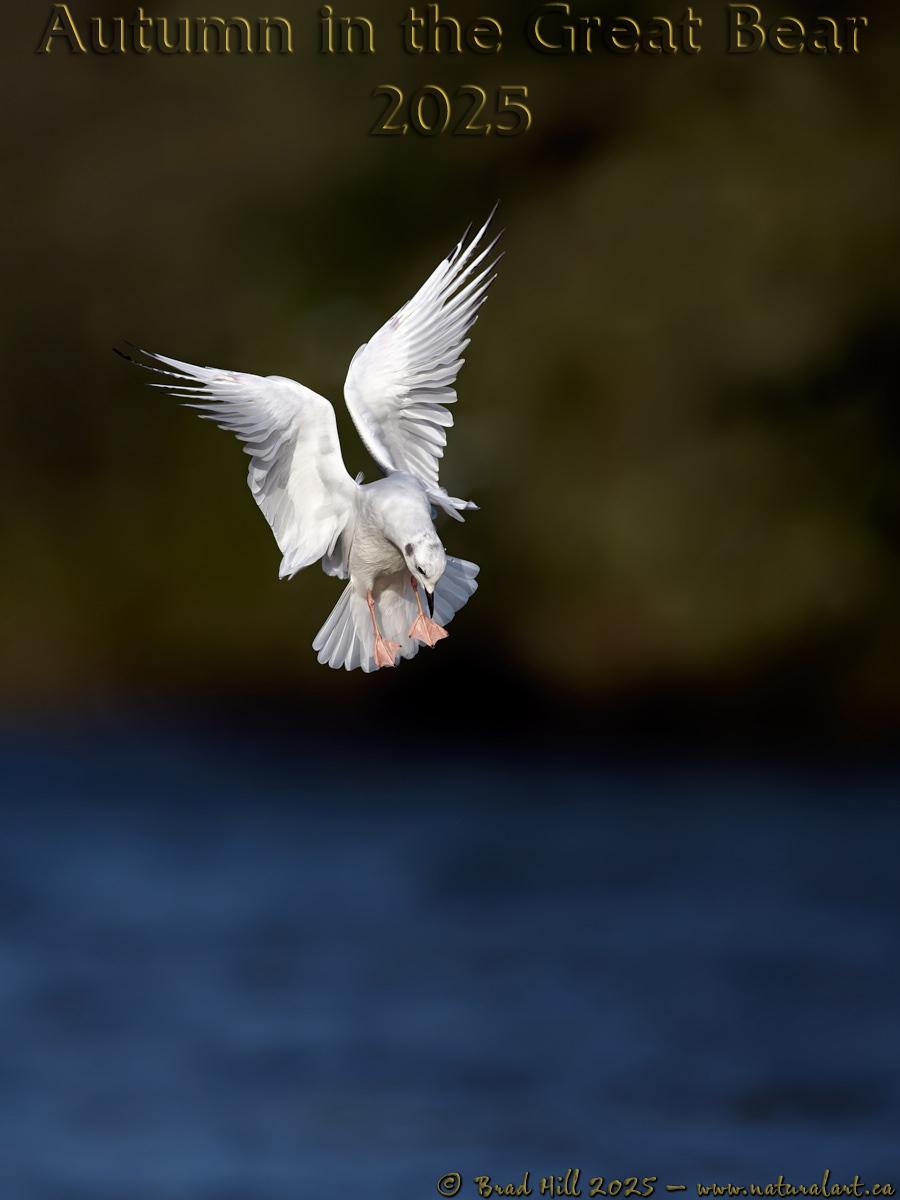
Bonaparte's Gull - Locked on Target. Great Bear Rainforest, British Columbia, Canada. September 23, 2025.
Ya gotta feel for those poor salmon (and their eggs)! They lead such a precarious life and the odds of them surviving from conception to breeding adult is astronomically low. Of the few thousand eggs laid and buried by a female salmon in gravel-bottomed streams only a very small percentage actually hatch. One source of egg mortality comes when it rains heavily and the flow in coastal rivers increases dramatically. During these times of high water flow a large proportion of the salmon's eggs are washed away. In this photo a Bonaparte's Gull (in non-breeding plumage) has just spotted one of those washed away salmon eggs near the surface and is just beginning its dive to pluck it out of the river. The dive was successful and the gull gulped down its prize. Gull 1 - Salmon Egg 0.
I captured this image using a Nikon Z 9 with a Sigma 200mm f2 lens (Sony E-mount, adapted for use on a Nikon with the Megadap ETZ21 Pro+ mount adapter). I took possession of the lens and adapter shortly before the photo tour where I captured this image. Among the many questions I had about using the adapted lens on a Z 9 body was how well the autofocus system would perform - specifically if the AF would be adequate to capture the type of action encountered when shooting wildlife. For me this meant capturing shots of various birds in flight, whales breaching or bubble-netting, wolves running, and grizzlies interacting (e.g., when sparring, chasing one another, etc.).
During the photo tour I had opportunity to shoot a few of these types of action with the Z 9 and Sigma 200f2 - specifically with bubble-netting humpbacks and LOTS of shots of gulls in flight. I obtained a very high hit rate with both of these subject types - as high as I would see shooting any Nikon Z-mount lens. But, if I'm being objective, these impromptu "tests" weren't really that demanding on the autofocus system of the Nikon Z 9 and adapted Sigma 200mm f2 (but note that they may represent the type of action wildlife photographers often encounter), so I'd hesitate to conclude too much from them.
So...once I returned home I took the opportunity to test the AF system of the Z 9 plus adapted Sigma 200f2 much more systematically and under more demanding conditions. One test I like to use to evaluate the AF performance of a camera/lens combination is the good ol' "dog running directly at me" test. I consider this to be an example of "extreme action" where the AF subject (the dog's nose pad and/or eyes) is moving up and down and thus across a huge portion of the viewfinder/frame and while it is also rapidly changing in distance to the camera. This test is roughly equivalent to shooting a fast-moving erratically flying bird as it is coming at the photographer, such as a swallow might do if you ventured too close to its nest site. Best of all, Joe the Portuguese Water Dog loves this game (he gets LOTS of treats) and he'll perform the exact same routine endlessly, allowing me to run trials of various AF systems during extreme action repeatedly. So darned handy! 😉
So I performed multiple "Joe the Portuguese Water Dog running directly at me" tests comparing the AF hit rate of the Sigma 200mm f2 (plus two other Sony lenses) on a Sony body (an A1 II) versus when the same lenses were adapted to and shot on a Nikon Z 9. My results from these tests? While they varied a little, overall the hit rate of the Sony mount lenses shot on a Sony A1 II beat the same lenses adapted for use on a Nikon Z 9 by about 15%. So...if a particular lens had a hit rate of 90% on the Sony A1 II it had a hit rate of about 75% when adapted for use on the Z 9. Interestingly, the vast majority of the missed shots with the Sigma lens and Z 9 combo occurred when Joe (the dog) was very close to the cameras (filling 60% or more of the frame) - at longer distances to the subject there was virtually no difference in the hit rates.
Keep in mind that it is impossible to say with any degree of confidence whether the reduced hit rate during these "extreme action" sequences was caused by the Megadap ETZ21 Pro+ adapter or by a difference in autofocus capabilities of the Sony A1 II vs. the Nikon Z 9. My GUESS is that the reduced AF hit rate is due to the Megadap mount adapter...but I have no direct evidence for this (yet).
Take home lessons? Personally, and based solely on AF performance with my normal subject matter, I won't hesitate to shoot the Sigma 200mm f2 mounted on my Z 9 with the assistance of the Megadap ETZ21 Pro+ adapter. For a good 99% of my wildlife photography work I am confident it will work just fine. If I happen to be in a situation where I KNOW the probability of extreme action is high (e.g., my goal is to shoot swallows in flight or I think I'm likely to be charged by a grizzly) then I will opt to shoot either a native Z-mount lens on my Z 9 (or a Sony body with Sony mount lenses).
Here's a larger version (4800 pixel) of this hungry gull about to strike for your perusal:
• Bonaparte's Gull - Locked on Target: Download 4800 pixel image (JPEG: 2.3 MB)
ADDITIONAL NOTES:
1. These images - in all resolutions - are protected by copyright. I'm fine with personal uses of them (including use as desktop backgrounds or screensavers on your own computer), but unauthorized commercial use of the image is prohibited by law. Thanks in advance for respecting my copyright!
2. Like all photographs on this website, these images were captured following the strict ethical guidelines described in The Wildlife FIRST! Principles of Photographer Conduct. As such, no baiting or any form of attractant was used and, as always, we attempted to minimize our impact on the ongoing behaviour of the subjects. I strongly encourage all wildlife photographers to always put the welfare of their subjects above the value of their photographs.
3. This image was captured during my Autumn in the Great Bear Exploratory Photo Adventure in early Autumn of 2025. Each year I offer photo tours into various locations on the amazing BC coast, including the Great Bear Rainforest and, every other year, into the Khutzeymateen Grizzly Sanctuary (to photograph grizzlies, of course!). Details about these trips can be found on the Photo Tours page of this website.
Behind the Camera
Bonaparte's Gull - Locked on Target. Great Bear Rainforest, British Columbia, Canada. September 23, 2025.
High Efficiency* Compressed RAW (NEF) format; ISO 90.
Nikon Z 9 paired with Sigma 200mm f2.0 DG OS Sports adapted to the Z-mount using a Megadap ETZ21 Pro+ mount adapter. Hand-held from moving Zodiac. VR on camera off; OS on lens on and set to Mode 2 (panning mode). Wide-area (L) AF area mode with subject detection mode set to Birds.
1/3200s @ f2; -1.0 stop compensation from matrix-metered exposure setting.
At the Computer
Bonaparte's Gull - Locked on Target. Great Bear Rainforest, British Columbia, Canada. September 23, 2025.
Initial noise reduction and capture sharpening on the .nef (raw) file using the DeepPRIME XD2S algorithm of DXO PhotoLab 9.2 Elite (using the lens/camera optical module of the Nikon Z9 + Nikkor 200mm f2 VR II)
Subsequent adjustments to the adjusted linear DNG file (exported from PhotoLab) and conversion to 16-bit TIFF file (and JPEG files for web use) - including all global and selective adjustments - made using Capture One Pro (build 16.7). In the case of this image only one global adjustment was made - an overall contrast bump using the Levels tool. Selective local adjustments performed using Capture One Pro's layers and masking tools. In this case numerous small adjustments and minor tweaks were made on 3 separate layers, with the tweaks being associated with "exposure balancing" and contrast adjustments (such as adjustments to brightness, clarity, highlights, shadows, blacks, etc.).
Photoshop modifications included insertion of the watermark and/or text.
Conservation
Autumn Daybreak. Great Bear Rainforest, British Columbia, Canada. September 23, 2025.
Species Status in Canada*: Of Least Concern.
The Bonaparte's Gull (Chroicocephalus philadelphia) is one of the smallest gulls in North America and can occur in almost any part of Canada or the USA (during at least part of the year). They breed in almost all of Canada and most of Alaska - and during the breeding season both males and females are black-headed. During the winter they are most commonly seen in the SE USA.
The Bonaparte's Gull does not appear to be globally threatened and numbers appear to have increased greatly in numbers since the early 1900's. Their conservation status is of "Least Concern".
Despite this positive conservation status the Bonaparte's Gull does seem to be sensitive to human disturbance and they've been known to fly over 1 km from their nest to attack and/or harass humans!
*as determined by COSEWIC: The Committee on the Status of Endangered Wildlife in Canada