






Bears
Marine Mammals
Wolves & Kin
Hooves & Horns
Other
Availability: Undetermined - Enquiries?







In the Field
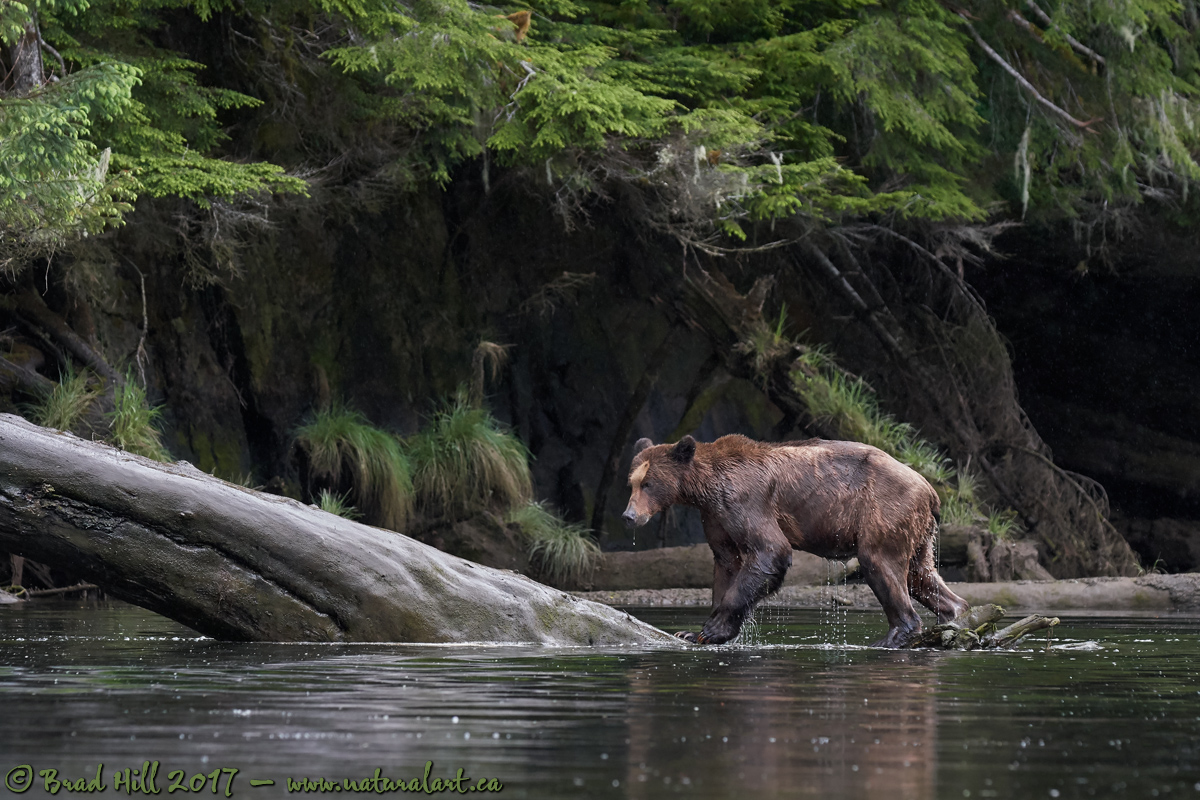
The Exit Ramp. Khutzeymateen Inlet, Great Bear Rainforest, BC, Canada. June 1, 2017.
Long before humans constructed highways and freeways the concept of an "exit ramp" was well-understood by our non-human brethren! Here a sub-adult male grizzly has just completed a rather invigorating swim across a channel in the Khutzeymateen estuary and, while still dripping wet, is about to climb the off-ramp into the surrounding forest. And, he doesn't even need the repetitively redundant signage that we adorn our roadways with to find his way onto the ramp! ;-)
I captured this image during an extended evaluation of the capabilities of Sigma's 120-300mm f2.8 Sport zoom lens. While I naturally "gravitate" towards prime lenses for a lot of my wildlife work, I'm like most wildlife photographers in liking the idea of having a zoom of high optical quality lens at my disposal. You know, one that offers tack sharp images and that provides me with more (and certainly "faster") compositional options than a prime lens does. But I have to say that MOST telephoto zooms with focal lengths suitable for wildlife shooting tend to be "aperture-limited" (or perhaps I should say "aperture-handicapped"?) when shooting in a low-light environment, especially if you pair them up with a cropped sensor (DX) body that doesn't have the ISO performance of some of Nikon's full-frame (FX) bodies (such as the Nikon D5). And that's the main reason why I was intrigued by - and wanted to test and evaluate - how the Sigma 120-300mm f2.8 Sport zoom paired up with Nikon's D500 (that fixed f2.8 aperture is just so compelling!).
This shot demonstrates extremely well what the Sigma 120-300mm f2.8 Sport "offers" when paired with a Nikon D500. This image was captured hand-held from a floating (= unstable) Zodiac with a moving subject - so going to a very low shutter speed simply wasn't an option. It was in "typical" Great Bear Rainforest low-light, and to capture the shot I had to push the ISO boundaries of the D500 to close to what I consider its limit - ISO 3600. Based on my own testing of the Sigma 120-300 I knew when it is stopped down to moderate apertures (in this case f5) it is very, very sharp...and definitely sharper than some other telephoto zooms (such as Nikon's AF-S 80-400mm f4.5-5.6 and their AF-S 200-500mm f5.6 or Sigma's and Tamron's 150-600mm f5-6.3 zooms) which would be wide open (or close it) at f5. And, of course, with the 120-300mm f2.8 I could have opened it up AT LEAST one stop more and STILL got a sharp shot (I chose not to here for reasons associated with depth-of-field).
No lens is perfect and they each have different strengths and weaknesses. Certainly, no one who has handled the Sigma 120-300mm f2.8 Sport lens would EVER call it svelte - and for some shooters the weight of the lens might scare them off. But in the low-light world where I do a lot of my wildlife shooting the Sigma 120-300mm f2.8 Sport zoom simply makes my D500 a WHOLE lot more useful. How can a wildlife shooter NOT like an optically sharp f2.8 lens with an equivalent focal range of 180mm to 450mm?
Here's a larger (2400 pixel) version of this dripping wet bruin for your perusal:
• The Exit Ramp: Download 2400 pixel image (JPEG: 1.6 MB)
ADDITIONAL NOTES:
1. This image was captured during one of my "Grizzlies of the Khutzeymateen" photo tour in the spring of 2017. Each year I offer trips into two different parts of the Great Bear Rainforest as well as one to photograph aquatic mammals and oceanscapes near the northern tip of Vancouver Island. And, in selected years, I also offer photo tours to locations to capture other highly sought-after subjects, such as various boreal owl species and wildlife of Canada's Arctic. Details about these trips can be found on the Photo Tours page of this website.
2. This image - in all resolutions - is protected by copyright. I'm fine with personal uses of them (including use as desktop backgrounds or screensavers on your own computer), but unauthorized commercial use of the image is prohibited by law. Thanks in advance for respecting my copyright!
3. Like all wildlife photographs on this website, this image was captured following the strict ethical guidelines described in The Wildlife FIRST! Principles of Photographer Conduct. I encourage all wildlife photographers to always put the welfare of their subjects above the value of their photographs.
Behind the Camera
The Exit Ramp. Khutzeymateen Inlet, Great Bear Rainforest, BC, Canada. June 1, 2017.
Digital Capture; Compressed RAW (NEF) 14-bit format; ISO 3600.
Nikon D500 paired with Sigma 120-300mm f2.8 Sport lens @ 195mm (for an EFL of 292mm). Hand-held from moving Zodiac. OS on and in "OS1" mode, with OS1 stabilization customized to Moderate View mode; AF customized to Fast Priority AF.
1/400s @ f5; -0.67 stop compensation from "recommended" matrix-metered exposure setting.
At the Computer
The Exit Ramp. Khutzeymateen Inlet, Great Bear Rainforest, BC, Canada. June 1, 2017.
RAW Conversion to 16-bit TIFF using Phase One's Capture One Pro 10. Four raw variants (different versions of a single raw capture) processed, with the variants differing in exposure settings (0.25 stop total difference between the variants), shadow recovery settings, and noise-reduction settings.
Further digital corrections on resulting 16-bit TIFF files using Adobe's Photoshop CC 2017 and Light Crafts Lightzone. Photoshop adjustments included compositing (blending) of the four output files from the raw converter, very minor exposure tweaks, and final selective sharpening for web output. Final tone-tweaking performed using LightZone's "tonemapper" tool.
Conservation
The Exit Ramp. Khutzeymateen Inlet, Great Bear Rainforest, BC, Canada. June 1, 2017.
Ten percent of the revenue generated by this image will be donated to Raincoast*.
Species Status in Canada**: Special Concern (May 2002).
While Grizzly Bears (Ursus arctos) are not technically listed as "Endangered" in Canada, they have been extirpated from most of their historical range. Grizzly Bears are far more sensitive to intrusion/disturbance in their habitat than are Black Bears and are being increasingly forced into marginal habitat by human encroachment. The Great Bear Rainforest along the central and northern coast of British Columbia is one of the last strongholds of the Grizzly Bear in Canada, and even this population is coming under increasing pressure.
On December 18, 2017 the government of British Columbia banned grizzly hunting across the entire province. This major conservation victory came after decades of tireless work by many dedicated conservationists and ecologists and, most importantly, it reflects the opinion of the vast majority of British Columbians. And, it means that AT LEAST while the current government remains in power grizzlies are finally "safe" in British Columbia.
Now that we've at least temporarily won the battle to save grizzlies in BC, it's time to re-focus our efforts toward protecting ALL of BC's carnivores, including Gray Wolves, Black Bears, Cougars, Wolverines, and more! Simply put, there are no ecological, economic, or ethical arguments supporting the trophy hunting of carnivores.
In a great first step towards ending the hunting of carnivores throughout BC the Raincoast Conservation Foundation has developed a program designed to protect ALL carnivores within the Great Bear Rainforest. Details about this program can be found on this page on Raincoast's website. Check it out and, better yet, make a donation to help Raincoast purchase the remaining commercial hunting tenures in the Great Bear!
*The Raincoast Conservation Society (and Foundation) is an effective and efficient organization that has been fighting for protection of this unique habitat. If you are looking for a meaningful way to contribute to the conservation of this amazing ecosystem, Raincoast will provide maximal "bang" for your conservation dollars.
**as determined by COSEWIC: The Committee on the Status of Endangered Wildlife in Canada