






Bears
Marine Mammals
Wolves & Kin
Hooves & Horns
Other
Availability: Undetermined - Enquiries?






In the Field
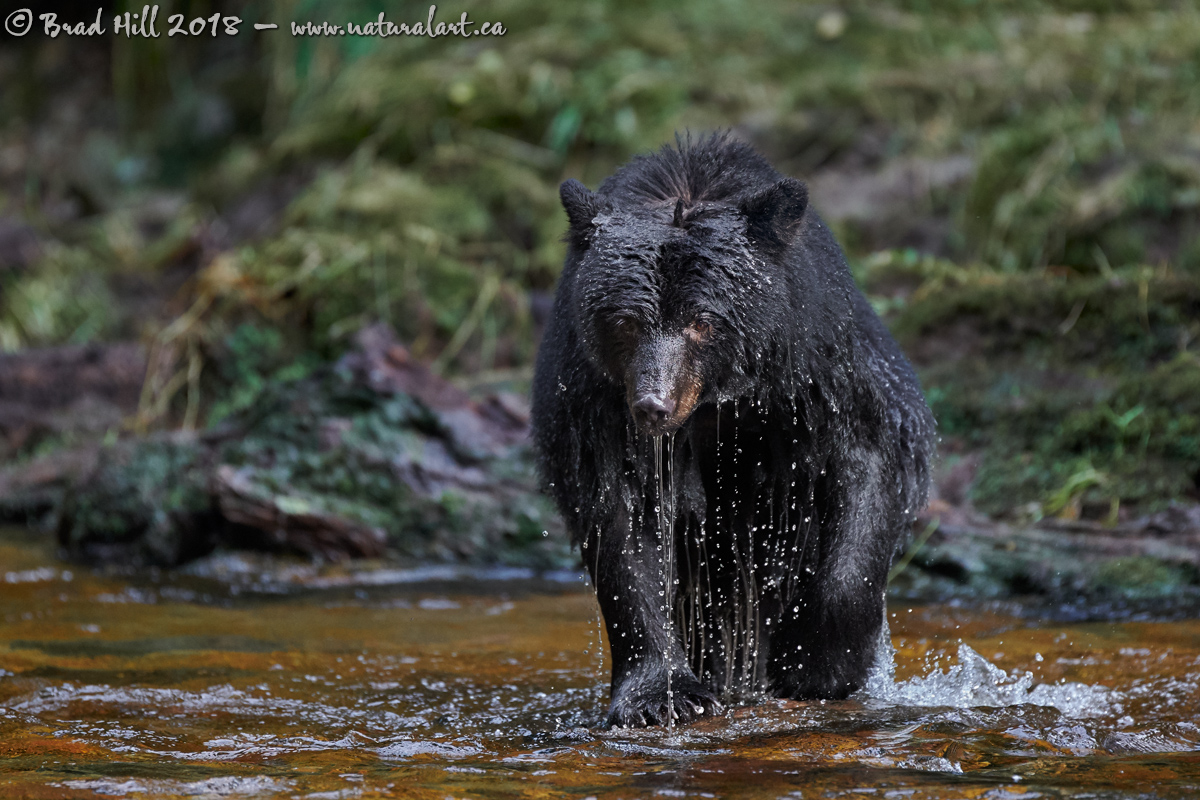
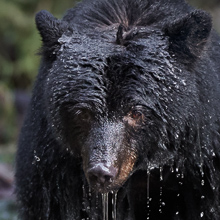
Salmon Fishing - It's a Wet, Wet Job! Great Bear Rainforest, Northern BC Coast, Canada. September 27, 2017.
There's some things humans can't avoid - like death and taxes (excepting on the latter, of course, if you're rich or Donald Trump). For a Black Bear in the Great Bear Rainforest the unavoidable is getting wet (soaked actually), especially when the salmon are running. I captured this image of this soaked and dripping Black Bear just after it made a fruitless head-first dive at a pink salmon in a deeper portion of this stream. But the bear was undaunted and was soon chasing and diving at other salmon (it wasn't too long before he prevailed and ended up with a fresh sushi dinner).
Every wildlife photographer has different gear needs and "desires" - there's certainly no one "size fits all" solutions in camera gear. Despite their weight and size (which would deter many photographers), I'm definitely a fan of fast telephoto lenses. Part of this is because I do a lot of shooting in very low-light environments and the light-collecting ability of f2.8 lenses can be a godsend.
But a bigger reason I gravitate to the "fast glass" tends to be in their enhanced ability to separate the subject from its background. As a wildlife photographer who shoots free-ranging, wild subjects in their natural habitat I have little control over subject placement in the scene. As most serious photographers know, the key element in being able to separate a subject from the background (i.e., keeping the subject sharp and softening the background) is ensuring the subject is further from the background than it is from you. Careful planning (and anticipation) in a field setting can help you get those critical distances right, but often you can do little about it. In those situations having a lens you can open up to f2.8 can really help.
In this case I had ZERO control over the positioning of the bear (and how far it was away from the busy background). Fortunately I DID have an f2.8 lens in my hand (in this case a Sigma 120-300mm f2.8 Sport zoom). So, I cranked the lens ALMOST wide open (to f3.2) and fired away. Why not WIDE open to f2.8? Well...I am yet to find a single lens (zoom or prime) that is as sharp wide open as it is stopped down just a bit (1/3 to 2/3 of a stop). My own testing of THIS lens has shown me that I get shots that are extremely close to maximally sharp at f3.2 (which is a big reason why the Sigma 120-300 f2.8 is a very important wildlife lens for me).
Here's a larger (2400 pixel) version of this absolutely drenched Black Bear for your perusal:
• Salmon Fishing - It's a Wet, Wet Job: Download 2400 pixel image (JPEG: 1.4 MB)
ADDITIONAL NOTES:
1. This image was captured during my autumn"Into the Great Bear Rainforest" Instructional photo tour in the summer of 2017. Each year I offer photo tours into several different parts of the Great Bear Rainforest as well trips to photograph marine mammals and oceanscapes in locations on the northern portion of Vancouver Island. And, in selected years, I also offer photo tours to locations to capture other highly sought-after subjects, such as Dall Sheep, Bald Eagles, and more. Details about these trips can be found on the Photo Tours page of this website.
2. This image - in all resolutions - is protected by copyright. I'm fine with personal uses of them (including use as desktop backgrounds or screensavers on your own computer), but unauthorized commercial use of the image is prohibited by law. Thanks in advance for respecting my copyright!
3. Like all wildlife photographs on this website, this image was captured following the strict ethical guidelines described in The Wildlife FIRST! Principles of Photographer Conduct. I encourage all wildlife photographers to always put the welfare of their subjects above the value of their photographs.
Behind the Camera
Salmon Fishing - It's a Wet, Wet Job! Great Bear Rainforest, Northern BC Coast, Canada. September 27, 2017.
Digital Capture; Compressed RAW (NEF) 14-bit format; ISO 3200.
Nikon D850 paired with Sigma Sport 120-300mm f2.8 Sport lens @ 300mm. Hand-held. OS on and in "OS1" mode, with OS1 stabilization customized to Moderate View mode; AF customized to Fast Priority AF.
1/1250s @ f3.2; no compensation from "recommended" matrix-metered exposure setting.
At the Computer
Salmon Fishing - It's a Wet, Wet Job! Great Bear Rainforest, Northern BC Coast, Canada. September 27, 2017.
RAW Conversion to 16-bit TIFF, including all global and selective adjustments, using Phase One's Capture One Pro 11. Selective local adjustments accomplished using Capture One Pro's layers and masking tools. In this case adjustments were made on 9 separate layers and included local/selective editing of exposure, contrast (via curves adjustment) colour desaturation, color editing, and both highlight retrieval and shadow recovery.
Photoshop adjustments were limited to image re-sizing, conversion of Prophoto RGB colour gamut (to sRGB), final sharpening for online display, and insertion of watermark.
Conservation
Salmon Fishing - It's a Wet, Wet Job! Great Bear Rainforest, Northern BC Coast, Canada. September 27, 2017.
Ten percent of the revenue generated by this image will be donated to Raincoast*.
Species Status in Canada**: Not currently listed as Threatened or Endangered.
This black bear is a member of the subspecies "Kermodei" (Ursus americana kermodei). This subspecies is unique in that the population is characterized by having an unusually high proportion of a recessive gene that produces white coat colour (found on the "Spirit Bears"). Because the Black Bear is not considered under threat as a species, both the Kermodei subspecies and the very rare Spirit Bear suffer from having the same conservation designation (it should be acknowledged that in British Columbia - the jurisdiction of greatest Spirit Bear abundance - hunting of these white-coated bears is not permitted). For reasons that are not fully understood, the Spirit Bear occurs with greater frequency in a relatively small geographic area within The Great Bear Rainforest of the central and northern coast of British Columbia. In this area 10 to 30% of the bears possess white coats. Many of the black-coloured Black Bears in this region carry the gene for white coats, so allowing hunting of ANY Black Bears in this region can reduce the frequency of the gene for white coats. Thus, to protect the Spirit Bear, it is necessary to prohibit the hunting of ALL Black Bears in this region. And, very unfortunately, the globally unique ecosystem that contains the Spirit Bear is under development pressure, especially from the forestry industry. If this unique environment is altered, we may lose the wonderful genetic anomaly known as the Spirit Bear forever.
*The Raincoast Conservation Society (and Foundation) is an effective and efficient organization that has been fighting for protection of this unique habitat. If you are looking for a meaningful way to contribute to the conservation of this amazing ecosystem, Raincoast will provide maximal "bang" for your conservation dollars.
**as determined by COSEWIC: The Committee on the Status of Endangered Wildlife in Canada