






Bears
Marine Mammals
Wolves & Kin
Hooves & Horns
Other
Availability: Undetermined - Enquiries?







In the Field
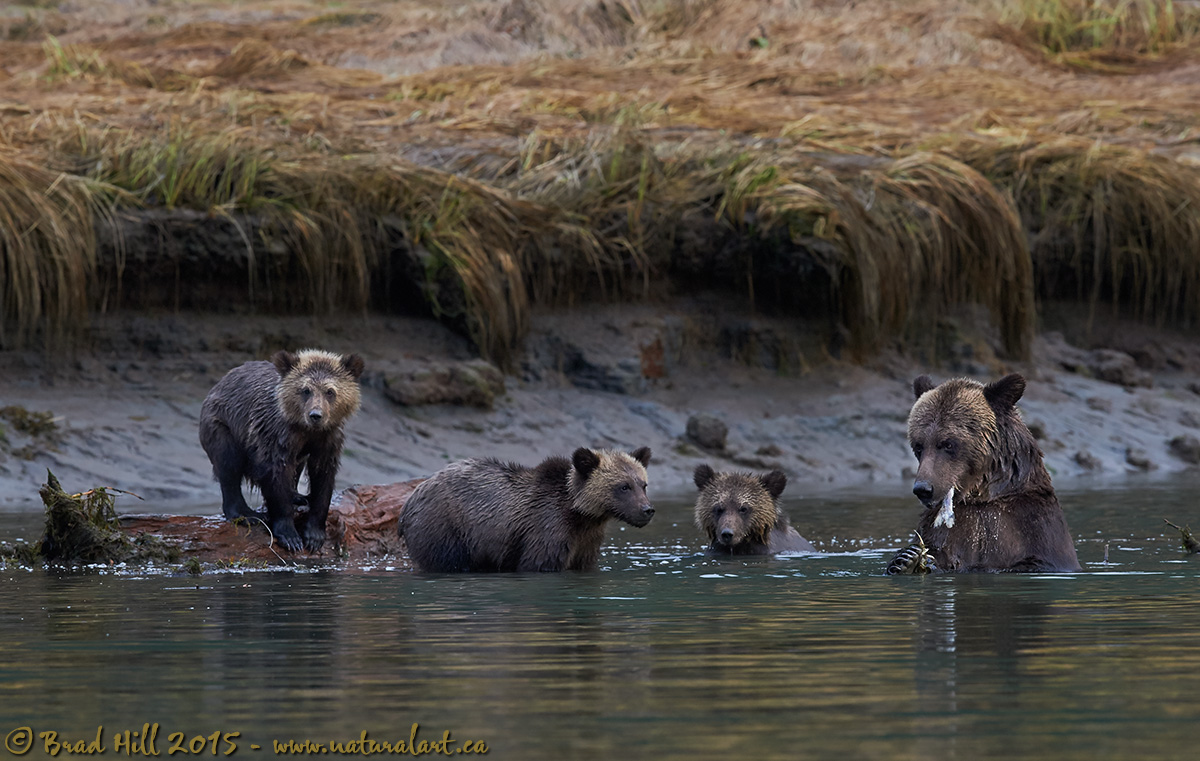
It's a Family Affair. Great Bear Rainforest (northern BC coast), BC, Canada. October 4, 2014.
We encountered this family of grizzly bears in a remote inlet in the autumn of 2014. Because of the remoteness of the location and the time of the year (definitely NOT sun-tanning season) we were able to spend some quality time with the bears completely on our own. As such, the bears had little distracting them and they could focus on doing what bears do in the autumn. And, of course, in coastal areas that means fishing! Here mom has caught herself a salmon and - like a good mom who knows she must keep herself in good shape so she can continue to look after her cubs - she was completely unwilling to share her bounty! The cubs did a little pleading and gave her some great mooching stares, but she was steadfast in her refusal to give up the goods.
This shot was captured in an estuary at the top of a long inlet. The bears are in one of many channels that bisects the grassy "delta" - and the 15-20' daily tides not only flood and completely cover the estuary (the shore below was completely submerged just a few hours after this shot was captured), but they also bring in new snacks and meals like salmon carcasses and other food for the bears on a frequent basis. So each day the bears explore the estuary looking for whatever edible bits the tide brought in.
Working with multiple subjects is always a challenge and, because of the limited depth of field of "long" lenses, it's even more challenging when using a super-telephoto lens. I captured this shot with the Nikkor 400mm f2.8E VR prime lens. I was fortunate in that the 4 subjects aligned themselves ALMOST on the same focal plane, but I still had to stop down quite a bit (to f8) to ensure that all the subjects would be sufficiently sharp. At the time it was heavily overcast, so having a camera with me with outstanding ISO performance (the Nikon D4s) - and thus providing me with the option to stop down and still shoot at a fairly high shutter speed (1/400s) - was absolutely essential in allowing me to capture this shot. There's always an attraction in getting a camera with higher and higher resolution (like the D800-series of cameras from Nikon or the coming 5Ds cameras from Canon), but because a LOT of wildlife photography is done in low light I'll personally opt for better ISO performance over more resolution on my primary wildlife camera every time.
The detail in this shot is better appreciated in a higher resolution version of this shot - so here's a 2400 pixel-wide version for your perusal...
• It's a Family Affair: Download 2400 pixel image (JPEG: 1.3 MB)
NOTES:
1. This image - in all resolutions - is protected by copyright. I'm fine with personal uses of it (including use as desktop backgrounds or screensavers on your own computer), but unauthorized commercial use of the image is prohibited by law. Thanks in advance for respecting my copyright!
2. Like all wildlife images on this website, the subject is fully wild and completely unconstrained. Besides the potential impact of my presence, nothing has been done to intentionally alter or affect the ongoing behavior of the subject and, of course, there has been no use of any form of bait or other form of wildlife attractants (including vocalizations).
3. This image was captured during one of my two autumn "Into the Great Bear Rainforest" photo tours in October of 2014. Each year I offer trips into two different parts of the Great Bear Rainforest as well as one to photograph aquatic mammals and oceanscapes near the northern tip of Vancouver Island. And, in selected years, I also offer photo tours to locations to capture other highly sought-after subjects, such as various boreal owl species and wildlife of Canada's Arctic. Details about these trips can be found on the Photo Tours page of this website.
Behind the Camera
It's a Family Affair. Great Bear Rainforest (northern BC coast), BC, Canada. October 4, 2014.
Digital Capture; Compressed RAW (NEF) 14-bit format; ISO 4000.
Nikon D4s paired with Nikkor AF-S 400mm f2.8E VR - hand-held from floating Zodiac inflatable boat. VR on in Sport mode.
1/400s @ f8; -0.33 stop compensation from "recommended" matrix-metered exposure setting
At the Computer
It's a Family Affair. Great Bear Rainforest (northern BC coast), BC, Canada. October 4, 2014.
RAW Conversion to 16-bit TIFF, including first-pass/capture sharpening and slight colour tweaking using Phase One's Capture One Pro 7. Three raw variants (different versions of a single raw capture) processed, differing by a total of 0.5 stops in exposure. Variation between variants also included differences to shadow and highlight retrieval settings.
Further digital corrections on resulting 16-bit TIFF files using Adobe's Photoshop CC 2014 and Light Crafts Lightzone. Photoshop adjustments included compositing (blending) of the three output files from the raw converter, selective colour desaturation and selective sharpening for web output. Final tone-tweaking performed using LightZone's "tonemapper" tool.
Conservation
It's a Family Affair. Great Bear Rainforest (northern BC coast), BC, Canada. October 4, 2014.
Ten percent of the revenue generated by this image will be donated to Raincoast*.
Species Status in Canada**: Special Concern (May 2002).
While Grizzly Bears (Ursus arctos) are not technically listed as "Endangered" in Canada, they have been extirpated from most of their historical range. Grizzly Bears are far more sensitive to intrusion/disturbance in their habitat than are Black Bears and are being increasingly forced into marginal habitat by human encroachment. The Great Bear Rainforest along the central and northern coast of British Columbia is one of the last strongholds of the Grizzly Bear in Canada, and even this population is coming under increasing pressure.
On December 18, 2017 the government of British Columbia banned grizzly hunting across the entire province. This major conservation victory came after decades of tireless work by many dedicated conservationists and ecologists and, most importantly, it reflects the opinion of the vast majority of British Columbians. And, it means that AT LEAST while the current government remains in power grizzlies are finally "safe" in British Columbia.
Now that we've at least temporarily won the battle to save grizzlies in BC, it's time to re-focus our efforts toward protecting ALL of BC's carnivores, including Gray Wolves, Black Bears, Cougars, Wolverines, and more! Simply put, there are no ecological, economic, or ethical arguments supporting the trophy hunting of carnivores.
In a great first step towards ending the hunting of carnivores throughout BC the Raincoast Conservation Foundation has developed a program designed to protect ALL carnivores within the Great Bear Rainforest. Details about this program can be found on this page on Raincoast's website. Check it out and, better yet, make a donation to help Raincoast purchase the remaining commercial hunting tenures in the Great Bear!
*The Raincoast Conservation Society (and Foundation) is an effective and efficient organization that has been fighting for protection of this unique habitat. If you are looking for a meaningful way to contribute to the conservation of this amazing ecosystem, Raincoast will provide maximal "bang" for your conservation dollars.
**as determined by COSEWIC: The Committee on the Status of Endangered Wildlife in Canada