






Bears
Marine Mammals
Wolves & Kin
Hooves & Horns
Other
Availability: Undetermined - Enquiries?







In the Field
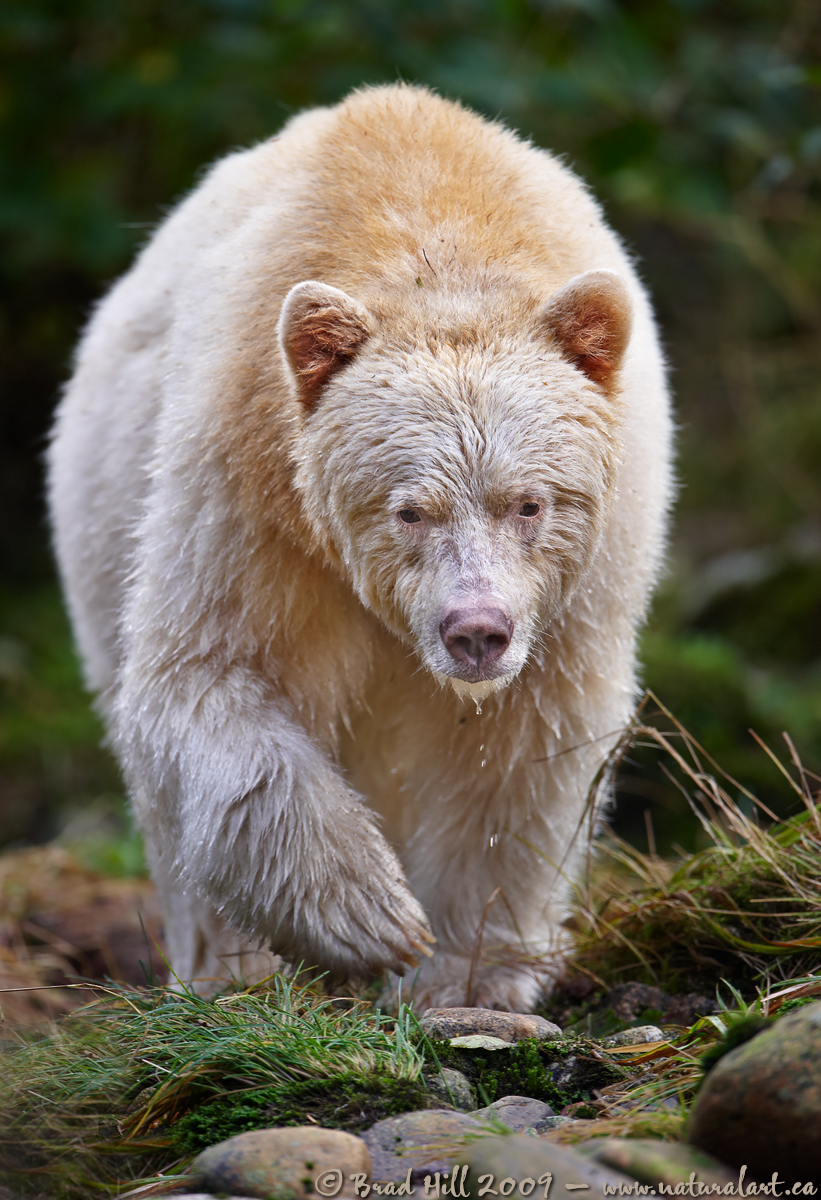
Spirit Bearing Down... Northern BC Coast (Great Bear Rainforest), BC. September 28, 2009.
Spirit Bears are extremely rare, white-phased forms of the American Black Bear (Ursus americana) - it is thought that between 200 and 300 exist on the planet. The white coat colour is controlled by a recessive gene which, for some unknown reason, occurs in higher frequency on a remote and tough to access roadless portion of the northern coast of British Columbia. On a few islands in this region between 10 and 20 percent of the bears are white Spirit Bears.
Spirit Bears are extremely challenging to photograph. The first reason for this is obvious - they're darned hard to find! And, if/when you do find them, you'll usually find that you're along a creek in the Great Bear Rainforest, which means that you're likely to be in a situation that is very poorly lit (and, not uncommonly, it will be raining). Finally, to compound the difficulties even more, if you're a photographer looking to capture shots with "catch-lights" in the bear's eyes - good luck: adult Spirit Bears have black, black eyes - and very long light-blocking eyelashes (much longer than their black-furred colleagues have) - that just suck up the light and seem to almost never reflect it back! While the name "Spirit Bear" comes from the significance of the white bear's role in native culture, I'm beginning to think the name is now being perpetuated by photographers frustrated by their inky black eyes that absorb light like a black hole in an almost ghoulish or zombie-like fashion!
I captured this Spirit bear "bearing down" on me (pun fully intended) along the side of a stream in the Great Bear Rainforest. The biggest challenge on this shot was finding a way to keep the critical regions of the bear AND the foreground in focus, all while freezing the motion of the paw with a relatively slow shutter speed (dictated by the low light). Fortunately for me, the bear chose a path which included a few spots where the foreground stacked up just right (to be in focus at the same time as the head). And, to freeze the paw, I tried to time my shutter so that it corresponded to the motionless apex of the walking movement...
A final word on the bear's eyes. I'm proficient enough in Photoshop to add convincing "catch-lights" to one or both eyes. But...to be blunt, this simply isn't my style. And, in this case, I find conveying the image closer to "as seen" more important (and interesting) than conforming to a rigid ruleset about what works (and doesn't work) in presenting an image.
Here's a larger (2400 pixel) version of this very focused Spirit Bear for your perusal:
• Spirit Bearing Down... Download 2400 pixel image (JPEG: 1.4 MB)
ADDITIONAL NOTES:
1. This image - in all resolutions - is protected by copyright. I'm fine with personal uses of them (including use as desktop backgrounds or screensavers on your own computer), but unauthorized commercial use of the image is prohibited by law. Thanks in advance for respecting my copyright!
2. This image was captured during one of my autumn "Into the Great Bear Rainforest" photo tours way back in 2009. Each year I offer trips into two different parts of the Great Bear Rainforest as well as one to photograph marine mammals and oceanscapes near the northern tip of Vancouver Island. And, in selected years, I also offer photo tours to additional locations to capture other highly sought-after subjects, such as various boreal owl species, fishing grizzlies, and more. Details about these trips can be found on the Photo Tours page of this website.
3. Like all wildlife photographs on this website, this image was captured following the strict ethical guidelines described in The Wildlife FIRST! Principles of Photographer Conduct. I encourage all wildlife photographers to always put the welfare of their subjects above the value of their photographs.
Behind the Camera
Spirit Bearing Down... Northern BC Coast (Great Bear Rainforest), BC. September 28, 2009.
Digital Capture; Compressed RAW (NEF) 14-bit format; ISO 400.
Nikon D700 with Nikkor 600 mm f/4G ED-IF AF-S VR lens - supported on Gitzo 1348 carbon fibre tripod with Wimberley head. VR on and set to "Tripod" mode.
1/200s @ f4; -0.33 stop compensation from matrix-metered exposure setting of camera.
At the Computer
Spirit Bearing Down... Northern BC Coast (Great Bear Rainforest), BC. September 28, 2009.
RAW Conversion to 16-bit TIFF, including first-pass/capture sharpening using Phase One's Capture One Pro 4.8. Three RAW conversions at different exposure settings. Exposure settings of 0 stops (for background and foreground) through to +1.0 stops (on the body of the bear).
Further digital corrections on 16-bit TIFF file using Adobe's Photoshop CS4. Photoshop adjustments included compositing and masking of 3 exposure versions, selective exposure curve adjustment, and selective sharpening for web output.
Conservation
Spirit Bearing Down... Northern BC Coast (Great Bear Rainforest), BC. September 28, 2009.
Ten percent of the revenue generated by this image will be donated to Raincoast*.
Species Status in Canada**: Not currently listed as Threatened or Endangered.
The "Spirit" Bear is a rare genetically-based colour variant of the common Black Bear (Ursus americana). It has been estimated that less than 300 Spirit Bears exist today. Because the Black Bear is not considered under threat as a species, the Spirit Bear suffers from having the same conservation designation (it should be acknowledged that in British Columbia - the jurisdiction of greatest Spirit Bear abundance - hunting of these white-coated bears is not permitted). For reasons that are not fully understood, the Spirit Bear occurs with greater frequency in a relatively small geographic area within The Great Bear Rainforest of the central and northern coast of British Columbia. In this area 10 to 30% of the bears possess white coats. Many of the black-coloured Black Bears in this region carry the gene for white coats, so allowing hunting of ANY Black Bears in this region can reduce the frequency of the gene for white coats. Thus, to protect the Spirit Bear, it is necessary to prohibit the hunting of ALL Black Bears in this region. And, very unfortunately, the globally unique ecosystem that contains the Spirit Bear is under development pressure, especially from the forestry industry. If this unique environment is altered, we may lose the wonderful genetic anomaly known as the Spirit Bear forever.
*The Raincoast Conservation Society (and Foundation) is an effective and efficient organization that has been fighting for protection of this unique habitat. If you are looking for a meaningful way to contribute to the conservation of this amazing ecosystem, Raincoast will provide maximal "bang" for your conservation dollars.
**as determined by COSEWIC: The Committee on the Status of Endangered Wildlife in Canada