






Songbirds
Birds of Prey
Grouse & Kin

Water Lovers
In Flight
Other







In the Field
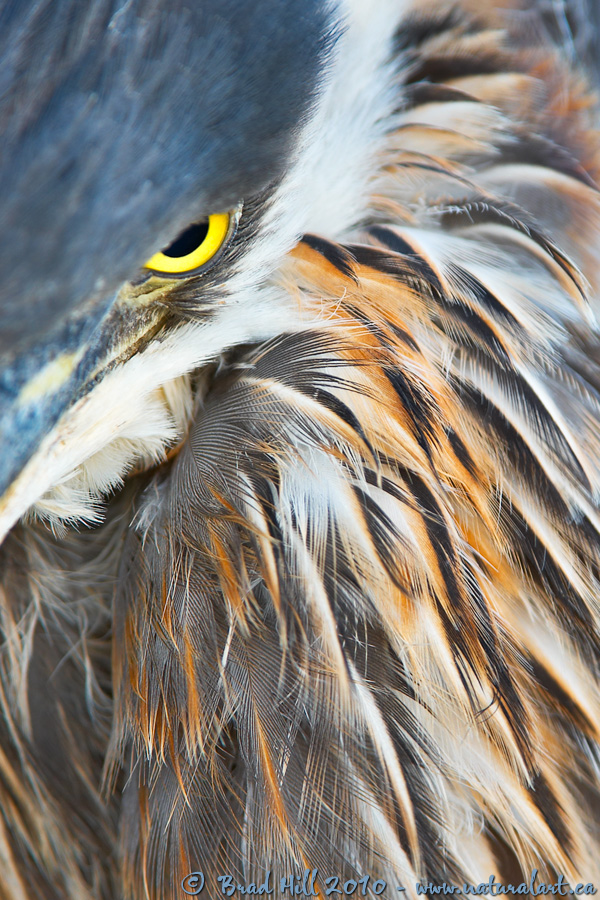
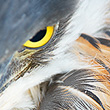
Eye of Heron. Columbia Lake, BC, Canada. July 24, 2005.
Blue Herons in my neck of the woods tend to be quite wary of humans and it's rare that you can approach them close enough to get "full frame" images of them. So I was very surprised when this lone, immature bird let me approach to within a few metres. At close range the rich, deep yellow of its eye - in contrast with the blue plumage of the head - was its most striking feature.
I wanted to emphasize the eye and make it "pop-out" in my composition. I knew that retaining all the detail in the plumage of head could potentially distract from the eye, so I chose a low ISO setting, a long lens, and a wide-open aperture that, in combination, allowed me to very selectively focus on the eye and effectively isolate it from the plumage on the bird's head.
Behind the Camera
Eye of Heron. Columbia Lake, BC, Canada. July 24, 2005.
Digital Capture; Compressed RAW (NEF) format; ISO 100.
Nikon D2X with Nikon 200-400 mm f/4G ED-IF AF-S VR lens @ 400 mm (600 mm equivalent with digital conversion factor) supported on Gitzo 1348 carbon fibre tripod with Wimberley head. VR turned to "On" and in "Normal" mode.
1/45s @ f4; no compensation from matrix-metered exposure setting.
At the Computer
Eye of Heron. Columbia Lake, BC, Canada. July 24, 2005.
RAW Conversion to 16-bit TIFF, including first-pass sharpening, exposure compensation, and tone curve adjustment, using Phase One's C1 Pro.
All further digital correction on 16-bit TIFF file using Adobe's Photoshop CS2, including selective saturation enhancement and selective sharpening for web output.
Conservation
Eye of Heron. Columbia Lake, BC, Canada. July 24, 2005.
Ten percent of the revenue generated by this image will be donated to Wildsight.
Species Status in Canada*: Pacific subspecies (Ardea herodias fannini) listed as species of Special Concern (April 1997); other populations and subspecies not currently considered at risk.
The Great Blue Heron (Ardea herodias) is the largest, most wide-spread and best known of the North American Herons. Great Blue Herons are monogamous but breed colonially in congregations known as rookeries. Legal protection of rookeries in many parts of North America have had positive results on their populations. Currently most of North America's populations of these birds are considered healthy and stable.
This immature Great Blue Heron was photographed in the Columbia Valley of the East Kootenays. Many ecosystems within the Columbia Valley face development pressure, including pressure from logging operations. Wildsight is an effective conservation organization that protects biodiversity and promotes sustainable communities in Canada's Columbia and Rocky Mountains. Support for Wildsight, through donation or becoming a member, will help ensure that they remain effective in their efforts to conserve threatened or endangered species and ecosystems.
*as determined by COSEWIC: The Committee on the Status of Endangered Wildlife in Canada