






Songbirds
Birds of Prey
Grouse & Kin
Water Lovers
In Flight
Other
Availability: Undetermined - Enquiries?






In the Field
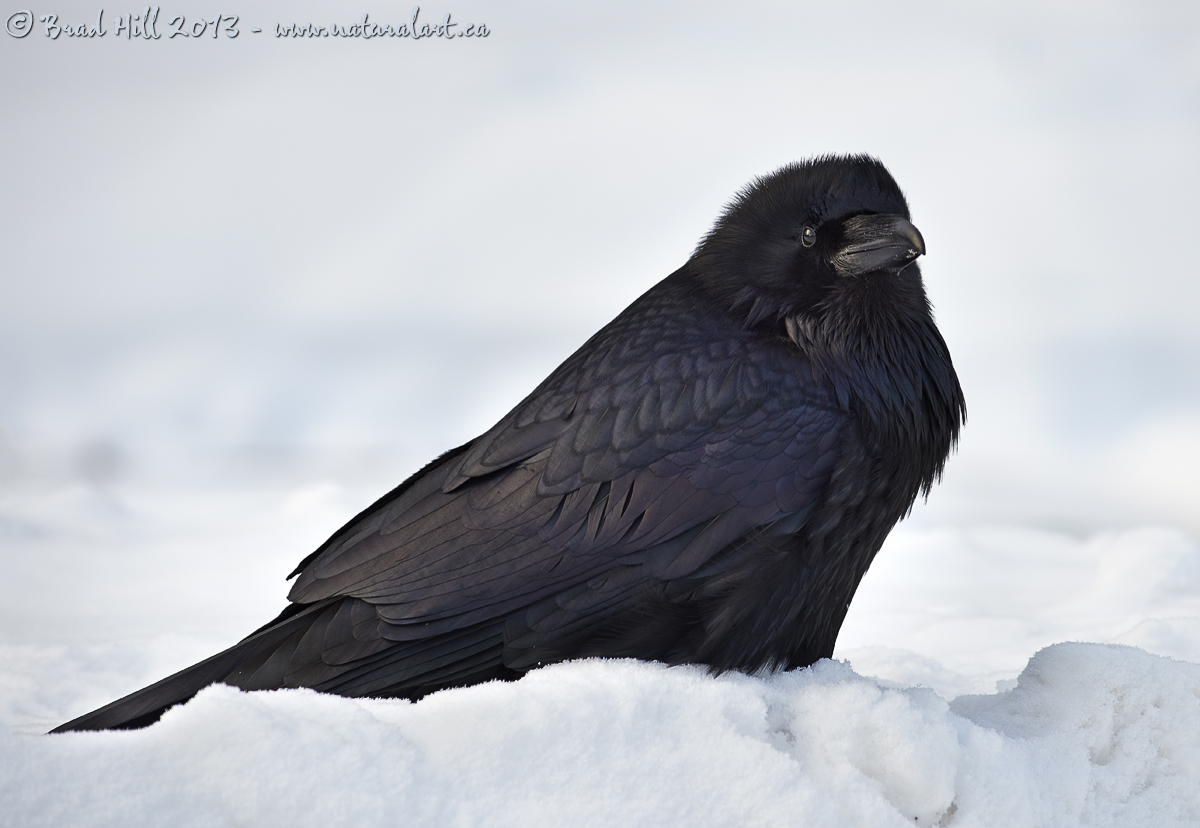
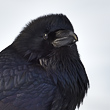
Black on White. Kootenay National Park, BC, Canada. December 28, 2012.
I've mentioned my personal liking of ravens before. Most folks tend to think of them simply as "big black birds" - but if you are lucky enough to get close to them you quickly realize that while they ARE very dark, their plumage contains many subtle hues - from blue and violet through to dark greens. But seeing those colours and capturing them in a photograph are two entirely different things...
I captured this image on a cold late December day in 2012. It was about -20C at the time (about 9 million below fahrenheit, or something like that) and the raven seemed content to save its energy resting on the ground. In my hands were two new bits of Nikon camera gear I was testing at the time - the D600 body and the "new" 70-200mm f4 VR zoom lens. I've been extremely impressed with both of these new products, but it was ONE characteristic of the D600 that really allowed me to capture this image as you see it - its amazing dynamic range. Back in the film era, and in earlier generations of the digital era, you would have been forced to make a compromise on this shot - either expose the image to retain the delicious dark-on-dark detail on the raven, or expose it to maintain a realistic look in snow by keeping that light-on-light detail. BUT, you couldn't have both in a single exposure. And...because of the dynamic nature of the subjects of wildlife photographers, the landscape photographer's solution to extending dynamic range by bracketing the exposure over multiple frames (and then combining them using some flavour of HDR software technique) simply isn't available for most wildlife shooting. The great dynamic range of this new camera (up to two or more stops better than was available in previous generations of camera bodies) is a huge step forward for any nature photographer who shoots high contrast scenes!
For those wishing to see even more of the detail in this shot - here's a 2400 pixel version of the image for your perusal..
Enjoy!
Behind the Camera
Black on White. Kootenay National Park, BC, Canada. December 28, 2012.
Digital Capture; Compressed RAW (NEF) 14-bit format; ISO 200
Nikon D600 paired with Nikkor 70-200mm f4 VR lens @ 175mm. Hand held. VR on and in normal mode.
1/200s @ f6.3; no compensation from matrix-metered exposure setting.
At the Computer
Black on White. Kootenay National Park, BC, Canada. December 28, 2012.
RAW Conversion to 16-bit TIFF, including first-pass/capture sharpening, using Capture One Pro Version 7.
Further digital corrections on resulting 16-bit TIFF files using Adobe's Photoshop CS6 and Light Craft's Lightzone. Photoshop adjustments included selective minor tweaks to exposure, selective increases and decreases to colour saturation, selective contrast adjustments (i.e., selective tone curve adjustments) and selective sharpening for web output. Final tone tweaking performed using tonemapper/re-light tool in Lightzone.
Conservation
Black on White. Kootenay National Park, BC, Canada. December 28, 2012.
Ten percent of the revenue generated by this image will be donated to Raincoast*.
Species Status in Canada**: This species is not designated as at risk.
The majestic Common Raven (Corvus corax) has an extremely broad geographic and ecological distribution - its natural distribution is one of the widest in the world. One factor contributing to this wide distribution is the huge range of foods (and feeding behaviour) of the raven - it's a scavenger, predator AND kleptoparasite. Its diet includes carrion, large numbers of arthropods, small rodents, bird nestlings, seeds, grains and more.
Ravens are considered to be among the most intelligent of birds and exhibit extreme behavioural plasticity. They will quickly learn innovative new methods to access food and even will form associations with other species (such as wolves) in order to obtain food. Some have even suggested that ravens will lead wolves to prey they have spotted from overhead, presumably so they can feed off the carcasses if the wolves make a successful kill (and once the wolves have had their fill).
*The Raincoast Conservation Society (and Foundation) is an effective and efficient organization that has been fighting for protection of unique habitats and species found in the province of British Columbia. If you are looking for a meaningful way to contribute to the conservation of BC's spectacular wilderness, Raincoast will provide maximal "bang" for your conservation dollars.
**as determined by COSEWIC: The Committee on the Status of Endangered Wildlife in Canada