






Songbirds
Birds of Prey
Grouse & Kin
Water Lovers

In Flight
Other
Availability: Undetermined - Enquiries?







In the Field
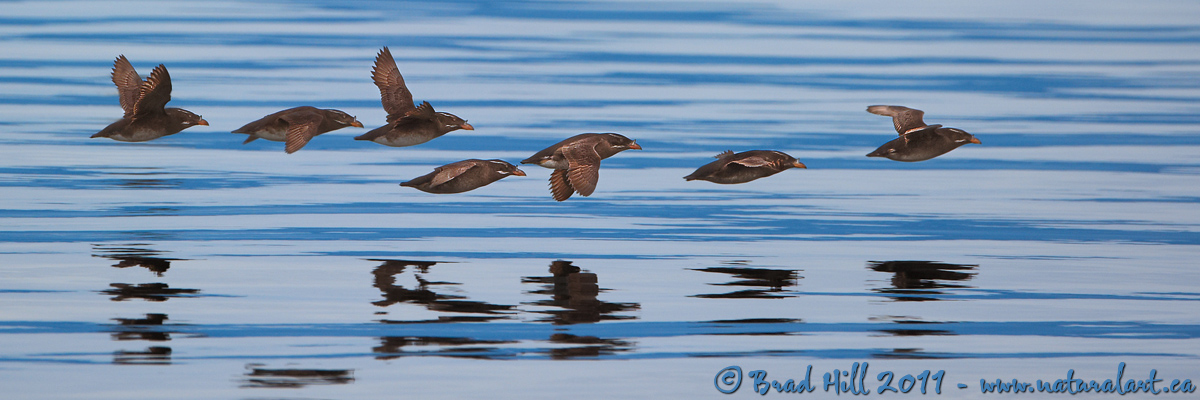
Rhinos! Johnston's Strait region of northern Vancouver Island, BC, Canada. August 20, 2011.
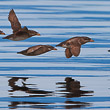
The glamour seabirds for most wildlife photographers include the three species of puffins found on the coasts of North American - the Horned, Tufted, and Atlantic Puffins. Personally, I find those dudes a little on the gaudy side - who the heck designed those over-sized and far-too colourful bills?? But...if you're looking for a REALLY cool seabird, look no further than the Rhinoceros Auklet - these little beauties are closely related to puffins (and quite similar behaviourally) and whoever designed them managed to strike a MUCH better balance between striking and subtle! The title of this image is based on what we'd loudly call out each time we saw a flock of approaching Rhinoceros Auklets - "Rhinos!"
During an aquatic mammal photo tour in the summer of 2011 we had - as always - some gaps in the action between sightings of whales, otters, and sea lions. During that time the rhinos provided us all with a really fun distraction as they zoomed by at about a gazillion miles per hour. This is one of my favourite captures of Rhinos in flight - it was amazingly nice of the rhinos to line up for me with no overlap, give me a bunch of different wing positions in single frame, and fly over water calm enough to cast some cool reflections. And, I love the ONE discordant reflection - not sure why that bird decided to cast such a differently positioned reflection (it wasn't closer to me than the others), but I'm glad it did!
Behind the Camera
Rhinos! Johnston's Strait region of northern Vancouver Island, BC, Canada. August 20, 2011.
Digital Capture; Compressed RAW (NEF) 14-bit format; ISO 640
Nikon D3s with Nikkor 600mm f4 VRII lens supported on carbon fibre Gitzo 1348 tripod with Wimberley head.
1/3200s @ f5; +0.33 stop compensation from matrix-metered exposure setting.
At the Computer
Rhinos! Johnston's Strait region of northern Vancouver Island, BC, Canada. August 20, 2011.
RAW Conversion to 16-bit TIFF, including first-pass/capture sharpening and levels adjustment using Phase One's Capture One Pro 6. Three exposure variants differing in total by 1.8 stops (from -0.8 stop through to +1.0 stops).
Further digital corrections on 16-bit TIFF file using Adobe's Photoshop CS5. Photoshop adjustments including compositing (layering and masking) of 3 exposure versions, selective exposure, curves, and saturation adjustments (all using adjustment layers and simple layer layer masks) and selective application of both cooling and warming filters (again using adjustment layers and simple layer masks), and final sharpening for web output.
Conservation
Rhinos! Johnston's Strait region of northern Vancouver Island, BC, Canada. August 20, 2011.
Ten percent of the revenue generated by this image will be donated to Raincoast*.
Species Status in Canada**: Not listed as Endangered, Threatened, or of "Special Concern"
The Rhinoceros Auklet (Cerorhinca monocerata) is a medium-sized auk that is closely related to puffins. They're distinguished from other auks (and puffins) by a very visible rhinoceros-like horn that projects above the upper portion of their bill (in breeding season). The function of this horn is unknown.
Rhinos occur throughout temperate waters of the North Pacific, generally to the south of the regions where puffins are found. Most breed on a small number of islands in British Columbia and adjacent parts of Washington and southeast Alaska.
*The Raincoast Conservation Society (and Foundation) is an effective and efficient organization that has been fighting for protection of this unique habitat. If you are looking for a meaningful way to contribute to the conservation of this amazing ecosystem, Raincoast will provide maximal "bang" for your conservation dollars.
**as determined by COSEWIC: The Committee on the Status of Endangered Wildlife in Canada