






Scenics
Extracts
Flora
Creepy Crawly
Animal Signs
Availability: Undetermined - Enquiries?







In the Field
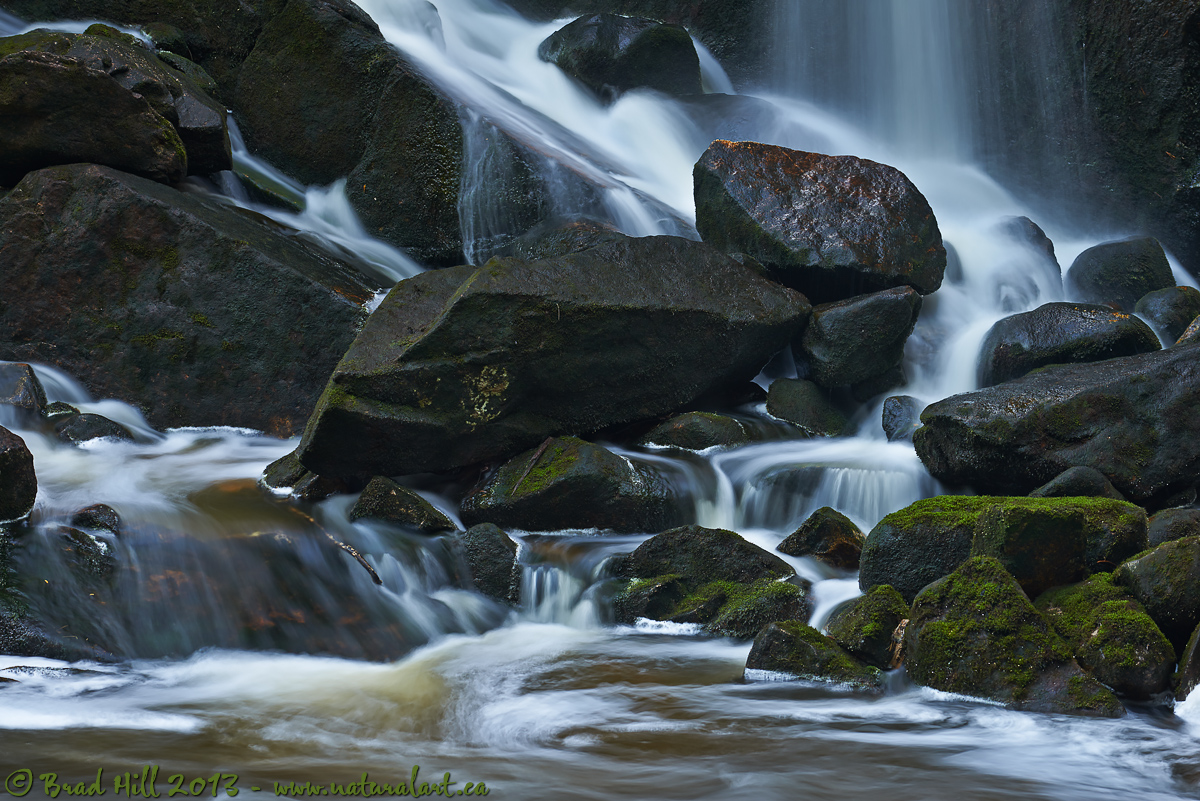
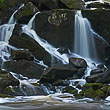
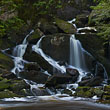
Undiscovered III - Rocks. Water. Moss. Great Bear Rainforest, BC, Canada. October 15, 2013.
This is the closest and "tightest" view I captured of a set of "undiscovered" waterfalls we found deep within the Great Bear Rainforest during an "Exploratory Photo Adventure" photo tour in the autumn of 2013. More about how we discovered the falls, and what about them appealed to me, can be found in the commentary on a wider angle shot of the falls called simply "Undiscovered".
This shot was taken from the exact same location - I simply zoomed in tighter to capture this view of them (and, like the previous images in the series, this is full frame, i.e., no cropping). The decision to tighten up a lot on the framing was driven by my desire to isolate and limit the shot to its three key elements - the running water (intentionally portrayed very softly), the angular and rigid rocks, and the soft, brightly-coloured moss. Like with both the previous shots, I chose to avoid adding any colour saturation or "going HDR" on this shot. So what you're seeing is pretty much exactly how the scene appeared to me in the field - naturally high-contrast, and naturally with a very narrow range of colour (tastefully applied, I hope!).
I've had some tell me this is the favorite of the three shots in this trilogy, mainly because, according to them, of the increased dominance (and "power") of the water in this shot. I see their point, but in my opinion this is largely a function of the limitation of the medium (online display) that the commenter was viewing the image. All three shots in this series are full-frame, and thus the hi-res original is over 7300 pixels wide. Which means they can be printed REALLY big. And, when they are printed big, the water looks great (and is an eye-grabber) in all 3 shots...
As with the other two images in this series, I'd love to show you the full 7360 pixel wide image (this shot is absolutely full frame with no cropping). But for reasons of practicality (and business concerns) that's not going to happen! ;-) But here's a reasonably hi-res (2400 pixel wide) version of it for you to chew on:
• Undiscovered III - Rocks. Water. Moss: Download 2400 pixel image (JPEG: 2.0 MB)
NOTE 1: This image - in all resolutions - is protected by copyright. I'm fine with personal uses of it (including use as desktop backgrounds or screensavers on your own computer), but unauthorized commercial use of the image is prohibited by law. Thanks in advance for respecting my copyright!
NOTE 2: This image was captured during a "Into the Great Bear Rainforest" exploratory photo adventure in the autumn of 2013. Each year I offer trips into two different parts of the Great Bear Rainforest as well as one to photograph aquatic mammals and oceanscapes near the northern tip of Vancouver Island. And, in selected years, I also offer photo tours to locations to capture other highly sought-after subjects, such as various boreal owl species and wildlife of Canada's Arctic. My next exploratory photo adventure (again into the Great Bear Rainforest) is scheduled for autumn 2015. Those who might be interested in this trip (and don't mind getting dirty, pushing their boundaries a little, and are on the mobile and fit side) should contact me at seminars@naturalart.ca. Details about all my photo tours can be found on the Photo Tours page of this website.
Behind the Camera
Undiscovered III - Rocks. Water. Moss. Great Bear Rainforest, BC, Canada. October 15, 2013.
Digital Capture; Compressed RAW (NEF) 14-bit format; ISO 100.
Nikon D800e paired with Nikkor 70-200mm f4 VR lens @ 110mm. Tripod mounted (Gitzo GT2541EX tripod with AcraTech GP-ss head). VR OFF. Live View mode (i.e., mirror up) and cable release. Circular polarizer.
1.3s @ f8; -0.67 stop exposure compensation from matrix-metered exposure setting.
At the Computer
Undiscovered III - Rocks. Water. Moss. Great Bear Rainforest, BC, Canada. October 15, 2013.
RAW Conversion to 16-bit TIFF, including first-pass/capture sharpening using Capture One Pro version 7. Two raw variants (different versions of a single raw capture) processed, differing by a total of 0.5 stops in exposure.
Further digital corrections on resulting 16-bit TIFF files using Adobe's Photoshop CC and Light Craft's LightZone. Photoshop adjustments included compositing (blending) of the two exposure variants, selective contrast adjustment to the water (via two selective curves adjustment layers) and sharpening for web output. Final tone tweaking performed using tonemapper/re-light tool in LightZone.
Conservation
Undiscovered III - Rocks. Water. Moss. Great Bear Rainforest, BC, Canada. October 15, 2013.
Ten percent of the revenue generated by this image will be donated to Raincoast*.
Species Status in Canada**: Not Applicable.
This image was captured along a portion of the coast of British Columbia that is known as the Great Bear Rainforest. It's the largest tract of intact temperate rainforest left on the planet.
The region this image was shot in is, at the time of this writing (December 16, 2013), facing a new and potentially catastrophic threat. There is a proposal to bring oil super-tankers through the narrow and treacherous channels of the Great Bear Rainforest. Any mistake, however small, while navigating through the Great Bear - such as the one that sunk the Queen of the North ferry on March 22, 2006 - could result in an oil spill with disastrous consequences. Find out more about the plan to industrialize this pristine ecosystem - and campaigns against the plan - at www.pipeupagainstenbridge.ca
*The Raincoast Conservation Society (and Foundation) is an effective and efficient organization that has been fighting for protection of this unique habitat. If you are looking for a meaningful way to contribute to the conservation of this amazing ecosystem, Raincoast will provide maximal "bang" for your conservation dollars.
**as determined by COSEWIC: The Committee on the Status of Endangered Wildlife in Canada